Introduction
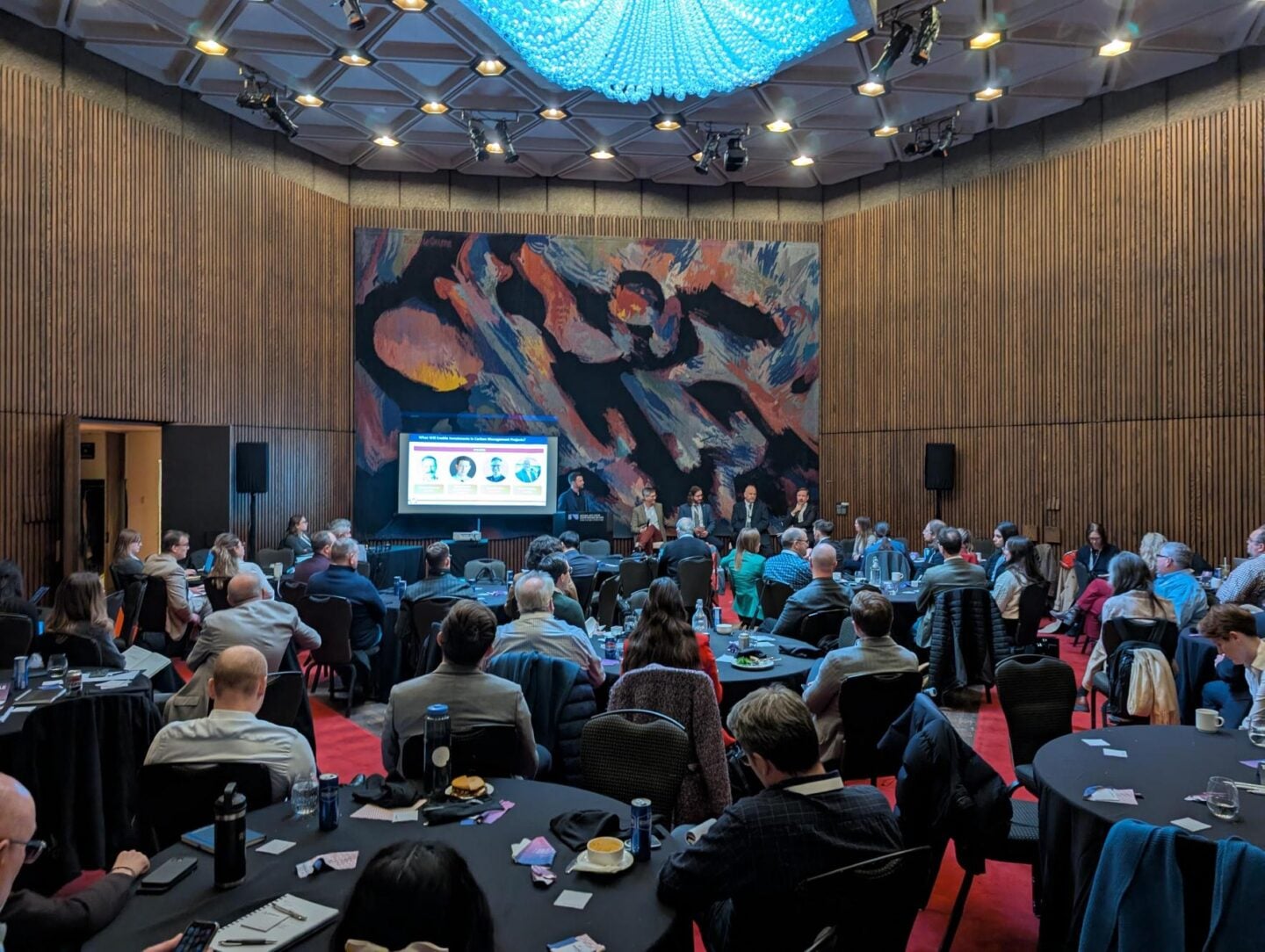
Carbon Management in Ontario and Quebec: What needs to happen now? was a two-day workshop held in Ottawa, Canada in February 2026. The event was held in-person at the National Arts Centre, with 90 attendees. Participants included representatives from industry, government, applied research organizations, academia, and non-governmental organizations. Organized and hosted by the International CCS Knowledge Centre, in collaboration with Geofirma Engineering, and sponsored by Natural Resources Canada (NRCan), the University of Waterloo, Geofirma Engineering, SLB, and Svante. The workshop explored the opportunities, challenges and practical steps needed to strengthen carbon management strategies in Eastern Canada, through presentations, fireside chats, panel discussions, break-out sessions, and networking opportunities. The agenda covered carbon storage regulations, federal CO2 transport and storage studies, prerequisites and economic sensitivities of carbon management, carbon markets and incentives, investments in carbon capture projects, carbon removal opportunities in Ontario and Quebec, storage options and risks in Eastern Canada, public engagement, and legal approaches.
Five core areas were focused on throughout the workshop presentations and roundtable discussions:
- Proven Carbon Storage:
- Technological Innovations
- Regulatory and Policies
- Carbon Markets and Incentives
- Public Engagement
Findings
Proven Carbon Storage
Proven carbon storage is a fundamental requirement for carbon management projects in Ontario and Quebec. Key considerations include site characterization, storage capacity, pressure management, monitoring requirements and the development of transport and storage networks to connect emitters to storage hubs.
Strengths
- Permitting pathways: Projects require certainty and simplicity for the permitting processes; both provinces have established pathways for sequestration.
- Eastern Canada Geological Atlas: Canadian Discovery has worked with partners on a new Eastern Canada Geological Atlas, covering 37 basins to standardize storage screening and identify data gaps.
- Significant capacity for geologic storage: New modelling estimates 1.1 gigatons of storage capacity in Ontario’s basal Cambrian sandstone, with approximately 70% located offshore in Lake Erie. Atlantic Canada has over 100 gigatons of storage capacity in offshore reservoirs. Offshore reservoirs can provide centuries of capacity for the entire Eastern Canada corridor, and there’s the potential to use the Maritimes Northeastern pipeline corridor to transport CO2, including potentially importing from Northeastern US. The CanmetENERGY team has estimated sequestration costs for southwestern Ontario at $50 per tonne, based on machine learning completed on injector numbers and storage area. In Quebec, the Potsdam sandstone formation near Bécancour shows promising storage and Questerre has completed 3D geomechanical modelling and reservoir simulation for injection and storage.
- Diverse technology options: Offshore wind in Atlantic Canada, coupled with large storage capacity offers opportunities for lower cost Direct Air Capture (DAC) projects. Mineralization opportunities are being explored in Quebec and Ontario, and permanent storage in the rock is promising.
- Modelling frameworks: The National CCUS Assessment Framework (NCAF) is a multi-modal and multi-temporal value chain planning framework. The framework actively mapped transport networks (pipelines, rail, shipping) using the ‘least-cost pathways’ to link industrial emitters in Ontario and Quebec with shipping ports and offshore storage options in Atlantic Canada. The long-term storage potential in Atlantic Canada could serve as the primary hub for Ontario and Quebec emitters, with over 100 gigatonnes of capacity. A transportation network will need to be developed to serve emitters.
Challenges
- Geologic uncertainty: There is still a lack of subsurface data in both Ontario and Quebec, specifically regarding in-situ stress, fracture mapping and aquifer compressibility. Collecting more data will enhance commercial modelling and reduce geologic uncertainty. Additionally, only one well has been drilled for carbon storage exploration in Ontario. Mineralization is promising, however the water volumes needed are a concern and currently mineralization is not an approved end use for CO2 under the CCUS-ITC.
- Geologic complexity: The Cambrian rocks in southwestern Ontario are complex and will require more detailed site characterization before hubs can be developed in the region. In addition, because Lake Erie is an interconnected and shared-border body of water, a CO2 storage project is complex. The province of Ontario has jurisdiction over the subsurface rights, pore space ownership and injection permitting; however, the federal governments of Canada and the US govern the environmental assessments. Quebec’s Potsdam sandstone, the area identified as having the highest potential for carbon storage in Quebec, exhibits low porosity and low permeability, requiring natural fractures to enhance reservoir properties. The expansive monitoring zones that will be required for dedicated storage sites are also a concern; pressure plumes can extend 10 to over 30km beyond the injection sites.
- Induced seismicity risks: Natural seismicity in southern Ontario and Quebec indicates a greater presence of faults than other provinces, like Alberta. This presents a likely risk of induced microseismicity and will be a critical issue requiring discussion prior to CO2 injection in the region.
- Competition for rights: Offshore wind rights and CO2 storage licenses may create a challenge on the East Coast.
Opportunities
- Funding to reduce geologic uncertainty: Targeted public funding to support geologic exploration in Ontario and Quebec would help reduce geologic uncertainty for project developers and unlock carbon storage potential for domestic and international industries.
Technological Innovations
Technological Innovation is essential to scaling projects as it can reduce costs, improve performance and expand the potential for carbon management. Key considerations include improving access to funding and demonstration opportunities, collaboration between innovators and industry, modelling to unlock regional opportunities, co-location and integration of different technologies, and de-risking.
Strengths
- Clean-tech ecosystem: There are currently 56 cleantech innovation companies in Canada, with 12 residing in Ontario and four in Quebec. Local innovators such as TerraFixing and Svante are engineering solutions to improve capture.
- Federal funding & global support: NRCan continues to support CCUS projects, allocating over 50% of recent RD&D funding toward the development of capture and carbon dioxide removal (CDR) technologies.
- The NCAF evaluates the entire CO2 lifecycle and accounts for environmental differences such as water use, land footprint and energy load requirements and has looked at over 140 facility archetypes representing the Canadian industrial landscape. NRCan then developed machine learning models trained on tens of thousands of cases to predict performance and costs based on flow, temperature, pressure and chemical composition – allowing the team to determine the environmental and economic ‘break-even’ for various capture configurations.
Challenges
- NCAF: Amine capture remains energy-intensive but there are breakthroughs in multiphasic amines which offer operational cost reductions of 20-40%, significantly lowering regeneration energy requirements.
- First-of-a-kind deployment risk: Novel technologies have a difficult time gaining financial support as companies looking to invest into CCUS tend to prefer incumbent amine-based technologies. New technologies will require additional de-risking to scale.
- Lack of early market access: Innovators struggle to connect with heavy emitters, despite a growing demand for decarbonization solutions in Ontario. A lack of collaboration between emitters and innovators risks the development of technologies that are incompatible with commercial facility demands.
- Standardized capture specifications: Transport and storage providers are operating with different specification requirements creating challenges for capture technologies. There are nitrogen and argon impurities in oxy-fuel capture and while electrolysis provides high-purity oxygen, non-standard capture technologies must manage these impurities to meet pipeline and liquefaction specifications.
- Cash flow: Most government grants provide innovators with reimbursements through contribution agreements. This can make managing cash flow challenging for innovators, as it requires large upfront spending. Alternative models that would provide installments after presenting a project plan would be more beneficial for scaling innovation.
Opportunities
- Navigating complex systems is challenging and risky, capital investment will follow certainty and simplicity. Deploying infrastructure and de-risking business cases would be the most helpful for innovation. [KM1]
- Modelling integration: Utilizing advanced modelling technologies, like the National CCUS Assessment Framework (NCAF) and tools like the Geologic Carbon Storage Atlas of Eastern Canada provides critical information on subsurface storage potential, risks and costs, unlocking regional opportunities.
- Synergistic hubs: Co-locating technologies like DAC in regions with abundant wind or hydro power (e.g. Quebec, Atlantic Canada) can maximize energy efficiency while reducing operational costs.
- DAC integration: There may be opportunities to integrate DAC with ammonia and electrolysis.
Regulatory and Policies
Developing regulations is an iterative process to reflect technical learnings as projects develop. The essential steps include site characterization, pore space access, measurement, monitoring and verification requirements, closure terms and the potential transfer of long-term liabilities to the Crown.
Strengths
- The availability of low-carbon electricity in Ontario and Quebec is an opportunity for carbon removal technologies.
- Regulatory developments in Quebec: Quebec’s Bill 17 provides regulatory clarity by declaring all underground reservoirs and pore spaces as the “domain of the State” (Crown property). Project proponents will now be able to apply for pore space directly with the government, avoiding potentially complex negotiations with private landowners.
- Regulatory developments in Ontario: Amendments to Ontario’s Geological Carbon Storage Act removed prohibitions on the injection of CO2 for carbon storage and established requirements and processors for obtaining pore space and approvals for regulated activities, as well as the operation and closure of carbon storage sites. Sequestration is restricted to a minimum depth of 800 meters. Applications for research and evaluation permits opened on February 1, 2026.
- Key federal supports: NRCan recently launched a continuous intake model for proposals to support Carbon Capture, Utilization, and Storage (CCUS) Front-End Engineering and Design (FEED) studies. Other key policies include the CCUS-ITC extension to 2035 and the Canada Growth Fund investments.
Challenges
- Pore space vesting in Ontario: Ontario vests pore space rights with surface landowners, not the Crown like Quebec. Therefore, project developers must negotiate with potentially many landowners to secure consent.
- Liabilities: While Ontario has created a pathway for transferring long-term geologic storage liability to the Crown, participants noted there isn’t clarity on how carbon-credit reversal liabilities will be handled.
- EOR: Quebec prohibits the production of petroleum production, and the amendments to Ontario’s Geologic Carbon Storage Act do not include the use of EOR for CCUS.
- Offshore jurisdictional gaps: Transporting CO2 to Atlantic offshore hubs involves navigating overlapping jurisdictions, which currently lack a unified regulatory framework.
Opportunities
- For projects to proceed there needs to be proven storage, strong regulations, financial support, innovation ecosystems as well as a robust workforce and supply chain. Successful projects currently require a clear split between public and private cost sharing. Carbon contracts for difference can reduce risks and protect projects from policy changes.
- Framework developments in Ontario: Ontario is looking to develop a competitive process for companies to bid on crown land for carbon storage, which would streamline project development. They are also continuing to develop post-closure stewardship funds or fees to ensure funds are in place to maintain the safety of storage sites indefinitely.
- New market opportunities: Enabling carbon management in Eastern Canada can unlock new market opportunities in Europe, as Canadian products have a competitive advantage due to existing trade agreements and the European Carbon Border Adjustment Mechanism (CBAM).
- Strategic Regional Integration: The storage potential in Atlantic Canada offers the opportunity to align Eastern Canada industrial decarbonization through a ‘Super Hub’; however, this integration faces significant challenges including the economic requirements for offshore transportation, the need for multi-modal CO2 transportation via pipeline and rail, as well as existing regulatory mandate gaps for offshore storage.
Carbon Markets and Incentives
Building upon existing carbon pricing systems and developing new markets is essential to de-risking and driving the net present value of projects. Key considerations include carbon contracts for difference, creating certainty in carbon markets, establishing offset protocols, and market transparency.
Strengths
- Capital costs and combined carbon prices are the most significant drivers of the net present value of projects.
- Carbon Contracts for Difference: Through the Canada Growth Fund projects can negotiate contracts for difference to provide assurance and protection from policy uncertainty.
- Market-based policies: Market-based policies, such as carbon markets, have proven to be a proven and predictable revenue source for carbon management projects. Provincial systems provide a framework to generate valuable, tradable offset compliance credits, while reducing emissions.
- Predictable carbon price signal: Mature carbon pricing systems in Quebec provides a credible, predictable price signal for CCS projects
Challenges
- Carbon market fragmentation: Canadian carbon markets are uncertain, uneven and underutilized, functioning as 10 different systems. Investors are hesitant to make long term commitments to CCS based on volatile credit values and uncertain markets. A unified national market, carbon contracts for difference, and a mechanism to ensure credit prices reach $130/tonne across systems are needed to create a more stable system.
- Carbon pricing bankability: The ‘bankability’ of carbon revenue remains a significant obstacle in Ontario and Quebec due to the uncertainty of carbon markets. CCUS projects require long-term investment and developers need long-term revenue certainty to transform carbon credits into reliable assets that can satisfy investors and support a viable business case.
- Carbon market variation: Ontario has changed their carbon market system three times in the past decade, first aligning with the cap-and-trade system in Quebec, then temporarily using the federal Output-Based Pricing System, before landing on the Emissions Performance Standards program in 2022. Shifting requirements can create uncertainties for CCS projects.
- Offset protocols: Ontario and Quebec both lack sufficient offset protocols, limiting opportunities for developers to generate and sell credits.
- Net Present Value: Project viability is extremely sensitive to policy and operational shifts. The following table summarizes the impact on Net Present Value (NPV) based on NRCan and Knowledge Centre modeling:
| Sensitivity Category | Impact Factor | Magnitude of NPV Impact |
| Government Support | CCUS ITC / provincial incentives such as ACCIP in Alberta | ~42% Change (High Sensitivity) |
| Capital Intensity | Initial CapEx | ~35% Change from nominal |
| Carbon Pricing | Combined Price / Credit Value | ~32% Change in project value |
| Operational Inputs | Power / Natural Gas Price | Moderate impact on daily OpEx |
| T&S Variables | Discount Rate / Tariff | Critical for long-term T&S viability |
| Throughput | CO2 Volume | High sensitivity; volume drives unit cost |
Opportunities
- Carbon Contracts for Difference (CCfDs): Expanding the use of CCfDs can help de-risk CCUS projects by bridging the gap between volatile market prices and the strike price, reducing uncertainty in carbon markets and enhancing the bankability of carbon revenue.
- Interprovincial and international credit trading: Modelling has shown a demand for opening carbon markets to interprovincial credit trading. There is also an increase in demand for carbon removals globally, and Canada has an opportunity to eventually sell credits into international markets.
- Market transparency: Mature markets such as the EU Emissions Trading System and California Low Carbon Fuel Standard publish prices on a regular basis. There is an opportunity for the Canadian government to publish credit prices to provide a more complete view of markets and their behaviour.
- Carbon Border Adjustment Agreements (CBAMs): CBAMs are becoming increasingly important for “trade-affected” industries looking to diversify their export markets. CBAMs can enhance and maintain the trade position and competitiveness of these industries across Eastern Canada under tightening global carbon constraints.
Public Engagement
All projects need a well-defined strategy for engaging with the public, Indigenous communities and other stakeholders throughout the lifecycle of the project. Key considerations include utilizing proven engagement strategies, discussing project risks and benefits, understanding concerns, raising awareness of technologies, and transparent communication.
Strengths
- Proven engagement strategies: Organizations such as PTRC Sustainable Energy and the International CCS Knowledge Centre have shown how to effectively engage with the public on carbon management projects. By engaging early, often and transparently, projects have seen success in building trust with local communities. Operating projects have a lot of lessons to share as well, for example Entropy worked with the municipality to demonstrate how their project protected the regional industrial tax base and secured a 15-year municipal tax exemption.
- Emphasizing co-benefits: Discussing co-benefits of carbon management projects, like their role in wildfire mitigation, and economic opportunities, help secure social license and trust with communities.
Challenges
- Social media disinformation: Online platforms provide spaces for misinformation to spread before developers can hold initial outreach meetings with communities, leading to increased opposition in some cases.
- Lack of awareness: Unlike parts of Western Canada, Ontario and Quebec are not as exposed to the oil and gas industry, leading to a lack of awareness and knowledge of geologic sequestration. Communication and engagement efforts that educate and increase the public’s awareness of sequestration and the regulations and safety systems in place would be valuable.
- Confidence in technology: Public confidence in CCUS technology varies, ranging from trust to skepticism. Continuing to share project learnings publicly, while being transparent about both the risks and benefits, can help build confidence and support projects in securing a social license to operate.
Opportunities
- Neutral third-party facilitators: Independent organizations, such as the PTRC and the International CCS Knowledge Centre, have proven expertise in supporting project developers with public engagement. As CCUS development scales across Canada, proponents should continue to leverage outside expertise to foster public trust.
- Digital transparency: Given the prevalence of misinformation online, project developers have an opportunity to leverage digital platforms to educate the public and create space for questions and concerns. Some projects have already adopted this approach, using online open houses and interactive maps to engage the public.