Canada’s Carbon Management Strategy recognizes the role direct air capture (DAC) technologies can play in meeting our long-term climate goals. To address emissions from hard to abate sectors and historical atmospheric carbon dioxide (CO2) emissions, the Strategy highlights the need for significant deployment of carbon dioxide removal solutions, which includes DAC.
While DAC offers a promising pathway for largescale CO₂ removal, the technology, only a limited number of DAC facilities are currently operating worldwide, and most projects are still in pilot or demonstration phases. Continued innovation is required to reduce capital and operating costs, improve system efficiency, and adapt DAC technologies to function effectively in Canada’s diverse climates, as differences in temperatures, humidity and even daylight hours can impact the DAC project’s performance and cost of capture. Advancements in these areas will be essential to enable fullscale deployment and to position Canada as a leader in the emerging global carbon removal industry.
What is DAC?
DAC is an engineered carbon dioxide capture technology that pulls CO2 directly from ambient air, and when paired with geologic storage, is a carbon dioxide removal (CDR) method.
DAC Process
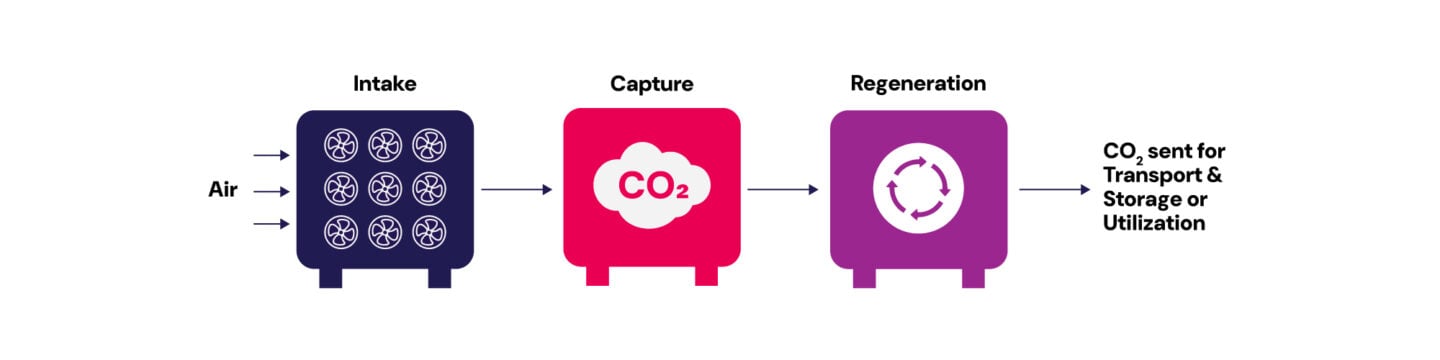
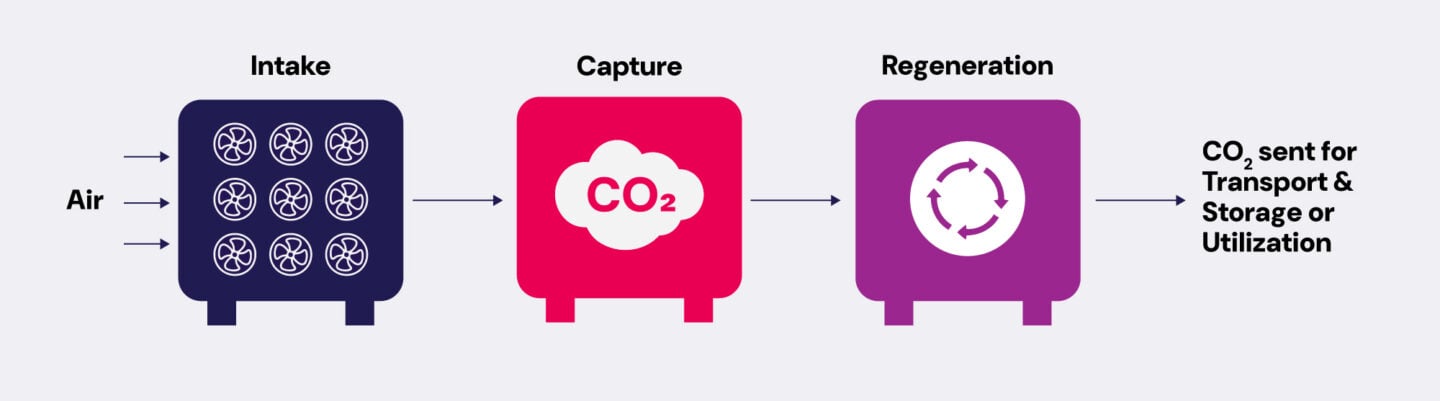
- Intake: Fans are used to draw in the ambient air, containing a CO2 concentration of approximately 0.04%.
- Capture: CO2 is captured using DAC technologies, which typically fall into two categories: solid DAC and liquid DAC. For solid DAC, solid sorbent systems (e.g., physical filters) chemically bind with the CO2 molecules, separating them from the air. Meanwhile, liquid DAC systems use a chemical solvent to absorb CO2 from the ambient air.
- Regeneration: The captured CO2 is then released from the solid sorbent or chemical solvent, typically through adding heat, and is compressed for transportation, utilization or storage. The regenerated solid sorbent or chemical solvent is used to capture more CO2.
How is DAC different from point source capture?
DAC is different from point-source capture, where CO2 is captured from industrial flue gases, Unlike point-source capture, DAC projects do not need to be located near industrial facilities. This allows them to be built wherever it makes the most sense, such as closer to CO2 transportation infrastructure or storage sites to help reduce costs. It also allows projects to build in their optimal environment to operate, because humidity, temperature and dynamic weather can impact capture abilities.
| Point-Source Capture | Direct Air Capture |
| Captures CO2 from the flue gas of industrial processes | Captures CO2 directly from the atmosphere |
| Flue gas contains 3-30% CO2 | Ambient air contains 0.04% CO2 |
| Required to be located with the industrial facility | Can be placed where the conditions are optimal |
| Addresses emissions of industries | Addresses emissions that can’t be reduced |
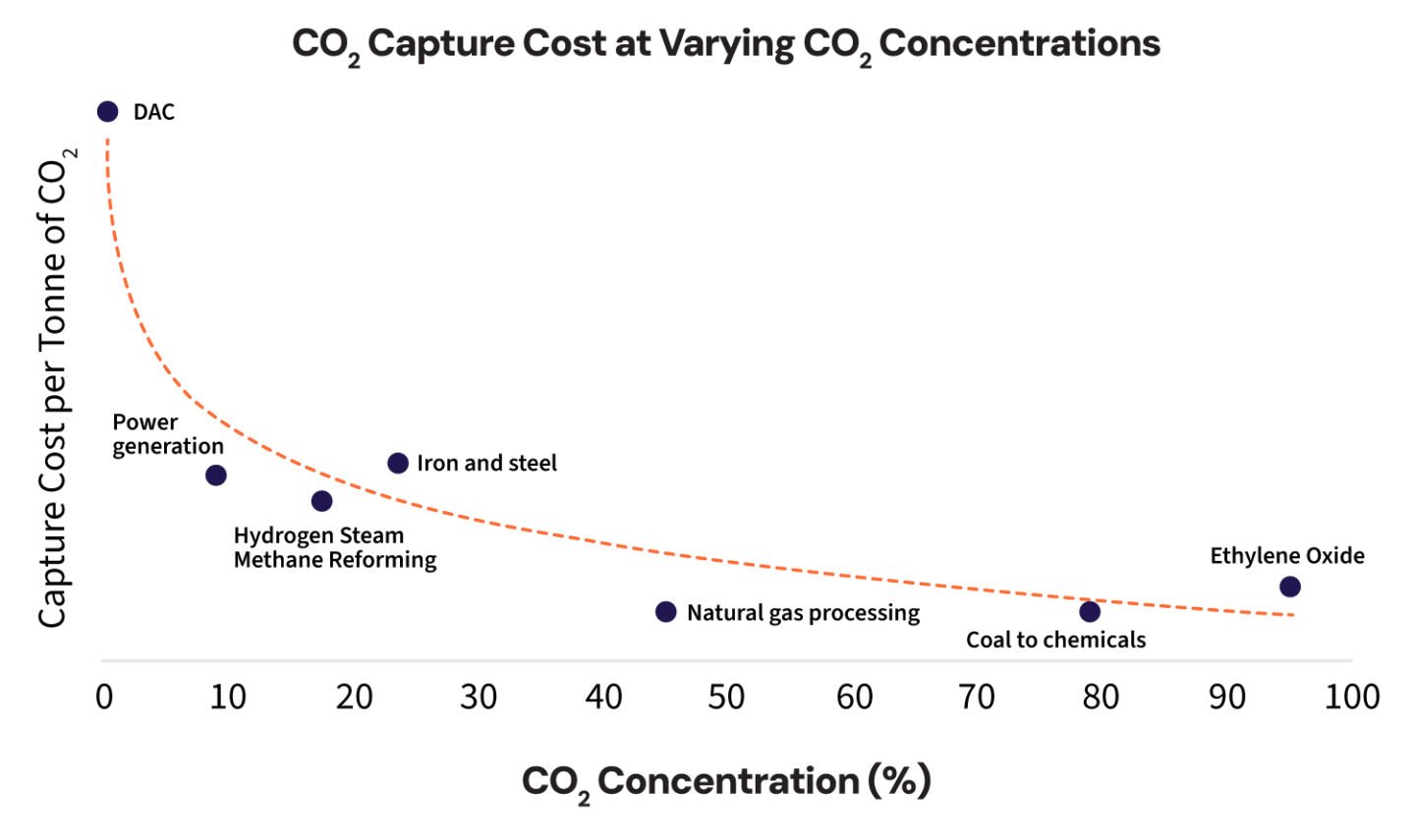
Removing CO2 at these low levels requires processing vast quantities of air, which often uses large fans, sizeable air contactors, and substantial volumes of high-performance sorbent materials.
In addition to this, the low levels of CO2 in the ambient air also makes DAC more energy intensive than point-source capture to capture the same amount of CO2. Substantial electrical energy is needed to power DAC modules, fans, pumps, compressors, and heaters. In addition, some DAC technologies also require thermal energy to regenerate chemical solvents or sorbents, which contribute to additional costs.
A graphic from IEA’s Direct Air Capture A key technology for net zero illustrates the cost of DAC relative to point source capture based on CO2 concentration is provided below.
Carbon Markets
One financial driver for DAC projects currently comes from the voluntary carbon market, where project owners can sell carbon removal credits to emitters around the world. This differs from Canada’s compliance markets, which are restricted to selling carbon removal credits within a given pricing system. Removal credits tend to sell for significantly higher prices on the voluntary carbon market than in compliance markets. Many global DAC companies and developers have secured advanced market commitments for carbon removals, essentially offtake agreements of DAC generated credits. These advanced market commitments are used by developers and technology companies to finance DAC projects.
Removal credits from geologically sequestered CO2 tend to sell at a premium compared to other types of credits because of their scarcity and their low risk of reversal. There are many organizations that certify voluntary removal credits to ensure their quality and permanence. The European Commission has recently adopted the first voluntary standard for permanent removals, a set of methodologies to certify CO2 removals including DAC with storage, and sets a precedent for government regulations (EU sets world’s first voluntary standard for permanent carbon removals – Climate Action).
Carbon Markets in Alberta
In Alberta, large industrial emitters are subject to the compliance credit market under Alberta’s Technology Innovation and Emissions Reduction Regulation (TIER). While DAC facilities would not normally be regulated by TIER, Alberta’s carbon capture and storage protocol enables DAC facilities to generate offset credits. The protocol also recognizes DAC generated credits as removals, although these credits don’t have higher value than other credits.
Importance of Energy Source for Carbon Removal Credits
To calculate net CO2 removals, DAC facilities must consider the CO2 emissions of their process inputs, including electricity and heat sources. The selection of energy sources for DAC projects directly influences the net CO2 removal, and using low-carbon electricity increases the number of removal credits these projects can generate and sell. To avoid carbon-intensive power grids, DAC facilities can source low-emitting sources using power purchase agreements (PPAs) or build behind-the-fence power generation.
General Categories of DAC Technologies
The current DAC landscape includes several different technologies, mostly distinguished by the materials they use to capture CO2 and the methods required to release and reuse those materials. DAC technologies generally fall into two well-established categories:
- Liquid DAC: Liquid DAC (L-DAC) systems use chemical solvents to absorb CO2 from the ambient air. Once the CO2 is absorbed, the CO2-rich solution enters a regenerator where it is heated at high temperatures (typically around 800 °C) to release CO2 gas from the liquid. The chemical solvent is recycled back to the capture unit to absorb more CO2. This type of regeneration process requires a significant amount of high-grade heat but benefits from using equipment with industrial precedent and existing supply chains.
- Solid DAC: Solid DAC (S-DAC) systems utilize solid sorbent systems, such as physical filters, which chemically bind with CO2 molecules, separating them from the air. These filters can be made of amine-functionalized materials, zeolites, or metal organic frameworks. Once the filter becomes saturated, the captured CO2 is released by heating the unit between 80°C and 120°C, reducing the pressure to create a vacuum, or using combination of both methods. The benefit of S-DAC systems is that they can be regenerated at much lower temperatures than L-DAC systems. This lower heat requirement may mean the project can utilize industrial waste heat for improved efficiency and cost savings.
Alternative technologies, especially electrochemical approaches, are emerging as promising pathways to reduce the energy consumption associated with DAC’s primary technologies. These methods use electrical energy to drive CO2 capture and release cycles through electrochemical reactions rather than thermal regeneration. Examples of this include:
- Electro-swing adsorption: Uses redox-active electrodes to adsorb CO2 when negatively charged and release it when a positive charge is applied. To learn more about this technology, visit here.
- Membrane electrodialysis: Moves CO2 captured in aqueous alkaline solvents through an electrodialysis stack to produce pure CO2 in a continuous loop. To learn more about this technology, visit here.
- Alkaline electrolysis: An alkaline solution captures CO2 before undergoing electrolysis (where an electric current drives a chemical reaction) to release the CO2. This process can also co‑produce hydrogen. To learn more about this method, visit here.
Enabling DAC in Canada
Canada is well positioned for DAC development, with extensive geological resources, such as deep saline aquifers and depleted oil and gas reservoirs, which are well-mapped and proven to be suitable for long-term CO2 storage. Canada’s workforce is well equipped with the expertise needed to support deployment at scale, and many educators across Canada have introduced programs specializing in carbon capture and management.
In addition, Canada has the regulatory frameworks for CO2 storage, with Alberta, Saskatchewan, and British Columbia having fully developed carbon storage frameworks in place, and other provinces currently in the process of developing their own. The country has developed additional tools to accelerate the deployment of carbon capture and removal technologies, such as carbon pricing and funding opportunities (click here to learn more about Canadian CCUS incentives). The CCUS Investment Tax Credit (CCUS-ITC), a federal government tax incentive, is one of the largest incentives available, which refunds up to 60% of capital investment on eligible DAC equipment costs, including dedicated combined heat and power support (to learn more about what types of DAC equipment is eligible for the CCUS-ITC, click here).
Despite the potential, DAC is still at an early stage of development, and significant innovation is needed to reduce the cost of capturing CO2. Projects like Deep Sky Alpha in Alberta, the world’s first cross-technology carbon removal centre, are helping to address this challenge by testing DAC technologies from around the world in Canada’s extensive climate conditions. Canada is also home to Carbon Engineering, which was founded in 2009 and continues to innovate large-scale DAC pathways from British Columbia. The team validates improvements at lab, pilot and demonstration scale.
While removals can generate credits in Canadian compliance markets, a lack of financial distinction between emission reductions and removals is incentivizing DAC project owners to access voluntary markets. In order for DAC to dramatically expand, the ability for hard-to-abate sectors to use carbon removal credits within Canadian compliance carbon pricing systems will likely be required.
Still have questions on DAC readiness in Canada? Check out Industry-and-Supply-Chain-Readiness-for-Direct-Air-Capture-in-Canada.pdf from Carbon Removal Canada and the International CCS Knowledge Centre.
For more information on CDR’s, explore Emissions Reduction Alberta and Alberta Innovates’ Carbon Dioxide Removal (CDR) Roadmap.

The CCUS Insight Accelerator (CCUSIA) is a partnership between the Government of Alberta and the International CCS Knowledge Centre to accelerate and de-risk CCUS by sharing knowledge and developing insights from projects.