Obtaining permitting is one of the most important steps when developing carbon capture, utilization and storage (CCUS) projects. To demonstrate that a project can safely capture, transport, inject, monitor, and ultimately close a carbon storage site, operators must secure regulatory approvals before operations can begin.
The longest and most comprehensive CCUS permitting process is for geological storage sites. These permitting processes ensure that projects meet environmental and public safety requirements and can verify the permanence of their stored carbon dioxide (CO2).
Permitting timelines can influence project economics, investment decisions, and the speed at which CCUS deployment can happen. Below we compare Alberta and the United States’ permitting timelines and regulatory processes for CO2 geological storage, highlighting how the systems work and where they differ.
Key Takeaways
When allocating permits for carbon storage projects, Alberta and the U.S. take fundamentally different regulatory approaches. Despite this, both jurisdictions effectively assess similar technical components such as site characterization, plume modelling, monitoring plans, and risk management.
The U.S. Environmental Protection Agency (EPA) Class VI framework consolidates most technical and operational requirements into a single, comprehensive permit. This results in a longer, sequential review process that must be completed before project construction and injection can proceed.
In contrast, Alberta uses a staged, regulator-led approach, where key approvals for carbon storage are managed by several Alberta Energy Regulator (AER) directives and are separated into a greater number of approval decisions. This allows technical reviews to be completed more quickly and promotes greater flexibility for project developers.
Alberta’s multi‑stage approval process delivers shorter regulatory timelines and offers greater flexibility in project scope and development approaches. Under the AER Directive 065, the CO2 sequestration scheme application reviews are to be completed within six months. Meanwhile, EPA Class VI permit approvals target ~24 months for completion, and have frequently extended three to five years.
In Alberta, recent Directive 065 sequestration application reviews took less than six months for the Wolf Lamont Carbon Hub, less than four months for the Bison Meadowbrook Carbon Hub, and less than seven months for the Enhance Origins CCS Project. In contrast, U.S. Class VI projects show significantly longer regulatory timelines: approximately 35 months for Oxy Low Carbon Ventures’ Brown Pelican project, 34 months for PureField’s Russell CO2 Storage Complex, and 19 months for ExxonMobil’s Rose Carbon Capture and Storage Project.
U.S. state primacy programs (e.g., North Dakota, Wyoming) have achieved timelines closer to Alberta. Although in both Canada and the U.S., project-specific factors such as geology, data availability, securing pore space rights and application quality, can significantly influence approval timelines and outcomes.
Direct permitting timeline comparisons are a bit of an ‘apples and oranges’ exercise. However, Alberta’s modular permitting structure provides greater flexibility and approval speed, while the U.S. EPA Class VI well process prioritizes comprehensive, front-loaded regulatory review.
Primary Approvals needed for Carbon Storage
Like all major subsurface activities, Government approvals are required for all aspects of carbon storage projects in North America. In most jurisdictions, there are four major approvals required of dedicated carbon storage projects:
- Securing storage space rights (pore space rights)
- Approval of project plans or schemes
- Authorization to begin operations and CO2 injection
- Project closure
These approvals are generally obtained in sequence. However, during the evaluation phase of a storage location, pore space acquisition, well site approvals, and storage project plan approvals may proceed in parallel.
Securing Pore Space Rights
Permanent storage works by injecting CO2 into small spaces within porous rock formations, saline aquifers or depleted oil and gas wells, collectively referred to as pore space. Before regulatory permitting can proceed, project developers must secure the legal right to use this pore space store CO2 in specific subsurface formations.
Securing pore space rights ensures that the project has authority to inject CO2 into the selected geological reservoir. It also considers potential conflicts with other subsurface resources and establishes the geographic boundary of the storage site. Pore space ownership varies by jurisdiction, with some deeming pore space as government owned, belonging to surface rights holders, or mineral rights holders.
| Alberta | |||
|---|---|---|---|
| Pore space title is held by the Crown (Alberta) and is separate from both surface rights and mineral rights. Carbon storage hubs (CSH) and small-scale remote (SSR) projects have different pathways to secure pore space in the province. | |||
|
Carbon Storage Hubs |
Small-Scale and Remote |
||
| Carbon Sequestration Evaluation Agreement | Carbon Sequestration Agreement | Pore Space Lease | Pore Space Unit Agreement |
| Provides access to evaluate pore space for carbon sequestration in a given area | Provides the right to CSH operators inject CO2 within a given area | Provides the right to inject CO2 as a singular project within a given area | Manages interested parties related to surface and mineral rights in the area related to the pore space lease |
| United States | |||
| Pore space title is determined at the state level by legislation or court decision. Some states have not yet determined pore space title. Pore space title is most commonly tied to the surface title in most states that have passed legislation related to pore space. | |||
| States with Pore Space Title tied to Surface Rights | |||
|
California, Colorado, Illinois, Indiana |
Kentucky, Louisiana, Montana, Nebraska |
North Dakota, Oklahoma, Pennsylvania |
Utah, West Virginia, Wyoming |
Storage Project Plan Approval
To demonstrate that a site can safely store CO2 over the long term, developers are required to submit a comprehensive project plan. These applications generally include evaluations of subsurface formations, predictions of the injected CO2 plume’s behaviour, and risk assessments related to site-specific characteristics. Applications include measurement, monitoring, and verification (MMV) plans, closure plans, emergency response procedures, and financial assurance mechanisms, ensuring that the project can be safely managed throughout its lifecycle.
In Alberta, this stage is primarily reviewed through the AER’s Directive 065 CO2 sequestration scheme application. In the United States, the equivalent approval is the U.S. EPA Class VI well permit, which includes a detailed technical review and public commenting process.
Injection Well Operational Authorization
Before CO2 injection can begin, projects must obtain approval to drill and operate injection and monitoring wells that are used to store CO2 underground. These approvals confirm that the wells meet appropriate engineering standards, and that operational conditions such as injection pressure limits and monitoring systems are in place. Operators must typically complete well integrity testing and demonstrate that monitoring systems are ready before receiving authorization to begin injecting.
In Alberta, CO2 injection wells, referred to as Class III Fluid Disposal Wells for CO2 Sequestration, must meet the requirements of several AER directives, covering requirements for well specifications, abandonment, operations, and emergency response plans. In contrast, before receiving authorization to inject CO2, the U.S. EPA requires operators to satisfy the pre-operational conditions of their Class VI permit, including well construction and testing requirements.
Post-Injection and Closure Approval
When CO2 injection ends, the project enters a closure phase where operators must demonstrate that the stored CO2 will remain safely contained in the subsurface. This stage includes plugging injection wells, monitoring the storage formation to confirm plume stabilization, and submitting final documentation to regulators. Once regulators are satisfied that the site no longer poses an environmental risk, the project may receive formal closure approval, and in some instances ownership of the site and/or management responsibilities are transitioned to government. Timelines for approving closure of sites and potential transfers of ownership and/or liabilities can vary greatly with some jurisdictions as short as 10 years and others exceeding 100 years.
In Alberta, operators apply for a reclamation certificate from the AER to recognize the site has been returned to a state similar to what it was prior to development. Following this, operators may apply to the Minister of Energy and Minerals for a closure certificate, and once the closure certificate is issued, certain long-term responsibilities and liabilities can be transferred to the province. Meanwhile, in the United States, closure occurs under the post-injection site care and closure requirements of the Class VI permit, which must be completed before the permit is terminated. In some states, like North Dakota and Wyoming, liabilities are transferred to state government.
To qualify for liability transfers, projects generally must meet all requirements and contribute to dedicated storage funds that ensure the CO2 remains safely and permanently stored in the subsurface and plans exist to monitor the site long-term.
Comparing Alberta and US EPA Permitting Timelines
Comparing carbon storage permitting timelines between Alberta and the U.S. can help illustrate how different regulatory structures influence project development timelines. While both jurisdictions require developers to demonstrate that CO2 can be safely injected and permanently stored, the way approvals are structured differs significantly. In the U.S., the EPA’s Class VI permitting framework is largely a single-track process centered on one comprehensive permit review before injection can begin. On the other hand, in Alberta, the process is managed by the AER within a broader, more flexible provincial framework. Projects are able to prioritize permits that they deem most impactful to overall project timelines. That is, a project can first pursue permits for a CO2 injection well, a CO2 pipeline or the carbon storage sequestration scheme. Because of these structural differences, timelines are best compared at the level of major project phases rather than individual permit decision points.
A number of factors shape permitting timelines, and these must be accounted for when drawing comparisons between the two jurisdictions.
- Jurisdiction matters in the U.S., Class VI permits may be issued either by the EPA or by states that have received regulatory primacy. Timelines can vary depending on the permitting authority and local regulatory capacity.
- Project-specific factors can significantly influence timelines, including the geological formation being used for storage, the availability of subsurface data, whether similar projects already exist in the region, and the overall scale and complexity of the project.
- Alberta’s regulatory framework varies based on the size of a project. Oversight is risk-based and therefore proportional to project size. For example, the process for obtaining pore space rights differs between large CSHs and small-scale and remote (SSR) projects, which may follow different evaluation and tenure pathways. In addition, Alberta allows some flexibility in the order of technical approvals; proponents may apply for a Directive 065 sequestration scheme approval before drilling injection wells and receive conditional approval pending submission of well penetration data, rather than requiring wells to be drilled prior to the storage scheme approval.
- The timeline for proponents engaging with the public and regulators can also substantially impact permitting timelines. Completeness of applications, regulator requests for additional information, and the timeliness of responses all contribute to longer permitting timelines.
These structural differences and project-specific factors mean that timelines presented in the comparison should be interpreted as illustrative rather than definitive. Below is a comparison of the Alberta and the U.S. EPA permitting processes projected timelines.
Securing Pore Space Rights
The timelines for securing pore space are highly variable and dependent on a number of factors across U.S. states and Canadian provinces.
In Alberta, pore space tenure is managed by Alberta Energy and Minerals unlike the technical approvals for projects which are managed by the AER. Alberta has two different processes to secure pore space, one for SSR projects (expected to be under 200kt per year and not close to a hub), and one for CSH projects, which must be successful in response to a Request for Proposal (RFP). For SSR projects, the process involves managing the interests of all potentially affected surface and mineral rights holders and finalizing a pore space agreement with the Government of Alberta.
Due to the smaller scale and limited area of interest for SSR projects, the process can be completed in a matter of months. Any delays would likely be related to project specific negotiations when securing agreements with interested parties. For projects that only involve one landowner or surface rights holder, like those in public areas, the process can be completed much faster.
As of March 2026, there were:
- 7 active pore space leases and
- 5 active pore space lease applications.
There have been three CSH RFP calls in Alberta since 2022. Successful RFP applicants are given the opportunity to sign carbon sequestration evaluation agreements. The initial agreements for the first two RFP calls were valid for 5 years after signing. Once evaluations have been completed, the CSH proponents can enter into Carbon Sequestration Agreements with the province of Alberta, providing them full rights to inject CO2 into given formations and areas listed in the agreement. The timeline for securing CSH pore space rights in Alberta is primarily proponent driven – projects can take time evaluating multiple injection sites and secure agreements with emitters before negotiating a carbon sequestration agreement with the province. For the initial projects, securing pore space took several years. However, this was driven less by the approval process itself and more by fiscal policy uncertainty and commercial considerations.
As of March 2026, the initial 25 Carbon Sequestration Evaluation Agreements signed in 2021 and 2022 have largely progressed through their evaluation periods:
- 6 have signed Carbon Sequestration Agreements,
- 2 have applied but not yet secured Carbon Sequestration Agreements,
- 7 have been cancelled and
- 15 are still active
In the U.S., the timeframes to secure pore space are more related to the timeline to secure pore space rights in each jurisdiction. In states where pore space rights are tied to surface ownership, the size of the project and the number of landowners within the area of review directly affect how long it takes to secure pore space rights. Examples in state leaders like North Dakota have ranged from around a year for some projects to multiple years due to court challenges, as is the case for Summit Carbon Solution’s storage project. Public outreach, including the negotiation and signing of pore space agreements, is the responsibility of project developers rather than state governments. Projects are not required to have fully secured pore space rights before starting regulatory permitting processes, but it is required prior to the authorization of CO2 injection.
Storage Project Plan Approval
The table below compares Alberta and U.S. regulatory timelines associated with CO2 storage project plan approval. It focuses specifically on the review of the storage project design and subsurface suitability, beginning with the submission of an application and ending with the regulator issuing a project approval or permit. The comparison excludes other project milestones such as pore space access, authorization to inject, well construction approvals, and site closure, which occur separately in both jurisdictions. While the regulatory processes evaluate many of the same technical elements, such as geological characterization, plume modelling, monitoring plans, and risk assessments, the structure and sequencing of the approvals differ.
| Phase | Alberta – Directive 065 CO2 STORAGE SCHEME Approval |
Typical duration (months) |
US EPA – CLASS VI PERMIT APPROVAL |
Typical duration (months) |
|---|---|---|---|---|
| Pre-application engagement (Developer work) | Proponent engages AER, completes modelling, site characterization, MMV plan and closure plan preparation. | ~<18 m | Early engagement with EPA to scope geological data requirements and modelling expectations. | ~<18 m |
| Application submission | Directive 065 scheme application submitted to AER including: reservoir characterization, plume modelling, risk assessment, MMV plan, and closure plan. | 0 m | Class VI permit application submitted including: geological assessment, Area of Review modelling, monitoring plans, financial responsibility and closure plans. | 0 m |
| Administrative completeness review |
AER reviews application for completeness and may request additional information. |
<1 m | EPA performs administrative completeness review and may issue notices of deficiency or requests for additional information. | ~1 m |
| Technical review (including additional information requests) | AER technical review of storage scheme including containment, injectivity, plume modelling, and risk mitigation measures. Iterative requests for clarification are common. | ~2 – 5 m | EPA conducts detailed technical reviews including modelling of plume and pressure front, well design, monitoring program, financial assurance and corrective action plans. | ~18 m |
| Draft approval / permit preparation | Notification requirements are largely handled prior to submission under Directive 056 and Directive 065 notification rules. | Parallel to application | Draft permit issued for public comment (minimum 30-day comment period) and possible hearing. | 1.5 – 3 m |
| Project plan approval (TOTAL) | Directive 065 scheme approval issued by AER | ~4 – 6 m | Final Class VI permit issued by EPA. | ~24 m |
The Alberta and U.S. systems assess similar technical components for geologic CO2 storage, but they organize them differently within their regulatory frameworks which can have an impact on project timelines. Once a Directive 065 CO2 Sequestration application is submitted and deemed complete, the AER sets a six-month maximum to make decisions and aims to do so even faster. Stakeholder notification requirements are also typically completed before or alongside the application process.
Other approvals, such as well licenses, occur later as separate regulatory steps. In Alberta, proponents may first apply for a CO2 sequestration scheme under Directive 065, including through an optional pre-drill pathway that links to the Directive 056 well licensing process. Additional guidance on these processes is available from the AER (AER CO2 Sequestration and Initiating new carbon capture well license application).
In contrast, the U.S. EPA Class VI permit incorporates most technical and operational requirements into one decision. The process includes a completeness review, an extensive technical review, preparation of a draft permit, a public comment period, and a final permit decision. The EPA’s stated goal is approximately 24 months from administrative completeness to permit issuance, although reviews have frequently taken longer, as shown in the EPA’s Class VI Permit Tracker.
Injection Well Operational Authorization
The table below compares the process for authorizing CO2 injection in Alberta and in U.S. states under EPA jurisdiction, after the storage project design has been approved. The duration refers to both the activity of developing the wells themselves and permitting approvals.
| Stage | AER | Typical duration (months) | US EPA Class VI | Typical duration (months) |
|---|---|---|---|---|
| Well construction / completion (Developer work) | Well design, injection wells drilled and completed, meeting Directive 051 requirements | ~6 – 8 m | Injection and monitoring wells constructed under Class VI permit conditions | ~6 – 8 m |
| Testing and baseline monitoring (Developer work) | Well integrity tests, injectivity tests, and baseline MMV data collected and submitted. |
~1 – 3 m |
Well integrity tests, injectivity tests, and baseline MMV data collected and submitted. | ~1 – 3 m |
| Regulatory authorization to inject | AER confirms wells meet Directive 051 well integrity requirements before injection begins | <1 m | Operator must satisfy permit conditions and obtain written authorization to inject from EPA | ~3 m |
| Injection begins | Injection allowed under approved scheme and well authorization | — | Injection allowed after EPA confirms pre-operational requirements | — |
AER separates injection authorization from the storage project approval. As noted above, Directive 065 scheme approval verifies the adequacy of the site’s geology, monitoring program, and overall project design. Injection may only commence once the injection wells have been drilled, tested, and confirmed to meet well‑integrity and associated requirements, including Directive 71 Emergency Response Plans. This structure allows developers to derisk a project by receiving approvals for various components in a flexible way rather than all at once. As a result, injection authorization typically occurs shortly after well completion, provided that testing and monitoring requirements are up to standard.
Under the EPA Class VI system, injection authorization is embedded within the Class VI permit rather than as a separate approval. The permit authorizes the construction of injection and monitoring wells and specifies the operational requirements for each of the pieces. However, CO2 injection cannot begin until the operator demonstrates compliance with pre-operational permit conditions, including mechanical integrity testing, baseline monitoring, and financial assurance. Authorization to inject is only granted after the regulator confirms these conditions are met.
Because Alberta separates project approval and injection authorization, regulatory review for the storage scheme can occur before wells are drilled, allowing project development and permitting to proceed in parallel. Meanwhile, in the U.S., the Class VI permit must be issued before well construction, meaning that the regulatory review for both project design and well authorization occurs earlier in the process.
Post-Injection and Closure Approval
The table below compares post-injection monitoring, closure process, and liability treatment for geologic CO2 storage projects in Alberta and under the U.S. EPA Class VI program. Both jurisdictions require operators to demonstrate that injected CO2 is stable and behaving in a predictable manner with no significant risks of leakage. The length of the monitoring period can vary by project, jurisdiction and project size. The length of monitoring periods in Alberta and the U.S. are also outcome based, though the U.S. has a default 50-year monitoring period that can be reduced based on site evaluations.
| Stage | AER | Typical duration | US EPA Class VI | Typical duration |
|---|---|---|---|---|
| End of injection | Operator ceases injection and continues monitoring under the approved MMV plan. | — | Operator stops injection and enters the Post-Injection Site Care (PISC) phase required under the Class VI permit. | — |
| Post-injection monitoring | Monitoring continues by the operator until the project shows that captured carbon dioxide is behaving in a stable and predictable manner, with no significant risk of future leakage. | Outcome-based | Operators must conduct monitoring and reporting during the PISC period to demonstrate that the plume and pressure front do not endanger underground sources of drinking water. |
Default 50 years with shorter periods possible. |
| Closure application | Operator submits a Closure Certificate application with monitoring results and risk assessment demonstrating containment. | After monitoring period | Operator submits documentation demonstrating that all PISC requirements and non-endangerment standards have been met. | After monitoring period |
| Regulatory closure decision | The Minister of Energy and Minerals issues a Closure Certificate if the regulator is satisfied that the site is stable and closure requirements are met. | Months for review | EPA approves site closure once monitoring data demonstrates non-endangerment and regulatory obligations are fulfilled. | Months to a year |
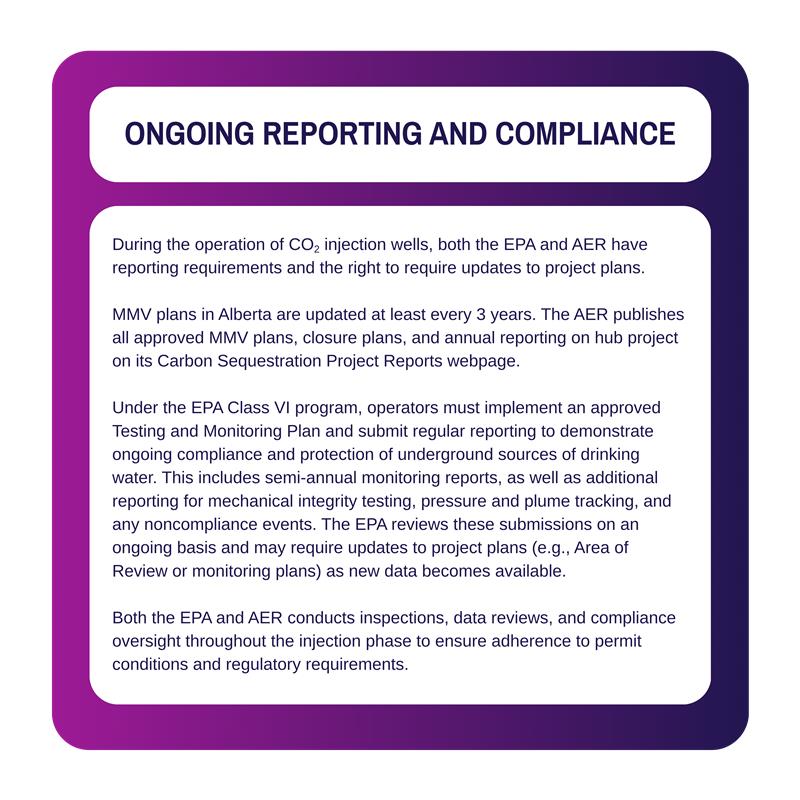
After closure certification and collection of the Post-Closure Stewardship Fund throughout operations, CSHs in Alberta may transfer certain long-term monitoring and statutory responsibilities to the Government of Alberta. This transfer occurs at project closure and helps limit long-term operator liability; however, it is only available for CSHs, not for SSR projects. U.S. federal rules generally do not provide a standard liability transfer mechanism, meaning operators typically retain long-term responsibility unless a state-specific program allows liability transfer.

The CCUS Insight Accelerator (CCUSIA) is a partnership between the Government of Alberta and the International CCS Knowledge Centre to accelerate and de-risk CCUS by sharing knowledge and developing insights from projects.