With the Carbon Capture, Utilization and Storage Investment Tax Credit, there could be a boom in Canadian CCUS projects before 2035. It’s important to know how the timeline of this critical program will impact supply chains.
The Canada Energy Regulator’s scenarios indicate that to reach 2050 climate goals, Canada will need to capture and store upwards of 60-80 million tonnes of carbon dioxide (CO2) annually, increasing from today’s capture and storage capacity of ~7 million tonnes per year. To help drive carbon capture, utilization and storage (CCUS) investments in Canada, the federal government developed the Carbon Capture, Utilization and Storage Investment Tax Credit (ITC), which can refund up to 50% of capital investment on point-source capture related equipment that is acquired by December 31, 2025
To take advantage of this incentive, and given the policy timeline and significant cost savings available to companies, many planned projects are likely to be constructed between 2028 and 2035.
If multiple CCUS projects are striving to meet the 2035 deadline, what are the corresponding impacts on supply chains?

The CCUS Insight Accelerator (CCUSIA) is a partnership between the Government of Alberta and the International CCS Knowledge Centre to accelerate and de-risk CCUS by sharing knowledge and developing insights from projects.
The supply chain study is based on a probabilistic model, estimating CCUS deployment based on the number of Canadian capture projects announced as of December 2024. In this model, it was assumed all projects would implement amine-based capture as it has proven performance and is commercially available, allowing projects to be operational prior to 2035. The study includes two scenarios:
- Current scenario: Companies are eligible to claim the ITC for eligible carbon capture equipment acquired by 2035
- Opportunistic scenario: Instead, companies are eligible to claim the ITC upon purchasing equipment and demonstrating start of construction by 2035
Click here to learn more about the study’s methodology and assumptions.
Projected C02 Captured Annually
-
Demand Type: Steel
Steel Demand vs Supply
Steel Demand
With the anticipated ITC deadlines, annual steel demand for capture facilities could peak and exceed the forecasted Canadian supply, creating bottlenecks and potentially impacting project timelines. Spreading the demand over a longer time frame significantly reduces pressure on the steel supply chain, minimizing risks of major market disruptions and corresponding delays for capture facilities.
-
Steel Demand by Type
-
2035 Global Steel Market Share by Type
Steel Market Insights
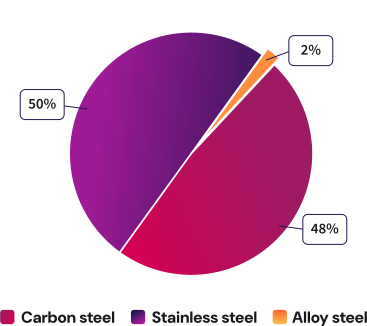
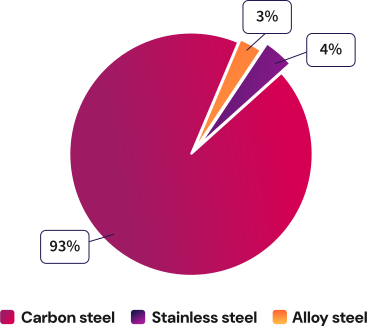
Steel usage in amine-based carbon capture facilities comprises mainly carbon steel and stainless steel, with alloy steel taking up 2% of total steel demand. The steel requirements specific to capture plants (~50/50 ratio for carbon steel and stainless steel) add a further complication to the supply chain as carbon steel is 93% of the steel produced globally, with alloy and stainless steels representing 3% and 4% of the market respectively. Global production of stainless steel and alloy steel may need to increase to keep up with the growing demand for carbon capture projects.
2035 Steel Market Share by Geography
Steel Market Share
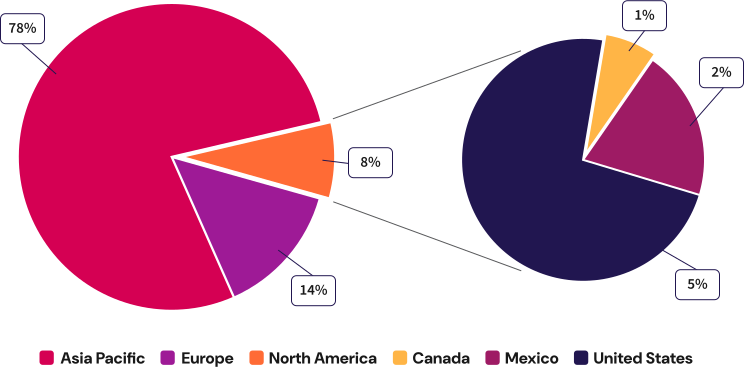
Several factors strain the steel supply chain for Canadian construction projects. According to Emergen Research, Canada’s share of the steel market accounts for only 1% of the global share, creating reliance on international producers. Capture plants require materials that meet very specific standards and specifications, and not all produced steel can be used. This limits sourcing steel from a select number of global manufacturers, including those in the USA, Europe, and parts of Asia, adding further complexities to steel supply for CCUS projects.
Demand Type: Labour
On-site Construction Labour Demand
Construction Labour
With the anticipated ITC deadlines, there’s potential for a high demand in construction labour, peaking in 2034 due to multiple CCUS projects being constructed at the same time. This could strain regional labour markets.
The CCUS ITC includes labour requirements related to prevailing wages and the inclusion of apprentices in project construction. Competition for skilled trades could arise, potentially leading to wage pressures or difficulties in staffing projects adequately, which could contribute to project delays and quality issues. By spreading the demand over a longer time frame, labour resources can be more effectively managed while reducing the risk of wage inflation.
For more information on labour supply, visit Careers in Energy and Build Force.
Operation and Maintenance Labour Demand
Operations & Maintenance Labour
The demand for operations and maintenance (O&M) labour grows over time as new capture facilities become operational. The anticipated ITC timeline requires rapid ramp-up of the O&M workforce by 2035. This implies a faster need for recruiting, training and deploying permanent O&M staff in a short amount of time. These occupations are also in high demand in other industries such as energy, mining, and manufacturing, making it challenging to attract talented personnel to this sector. The opportunistic scenario allows for a gradual build-up of O&M workers. Spreading the demand over a longer time frame allows more time for workforce planning, upskilling and recruitment, which could significantly reduce pressure on recruiting specialized O&M personnel in the short-term.
Demand Type: Amine Usage
Amine Usage
The ITC timeline is projected to drive a significant increase in amine demand by 2035.
Concerns over potential amine shortages stem from Grand View Research projections on the anticipated growth of the ethanolamine market in North America, which may struggle to keep up with rising demand. While base ingredient supply for generic amine production is expected to grow in North America and in other regional markets, uncertainties regarding transportation, competition and geopolitical factors may pose risks to the sustainable amine supply. The Canadian market could face higher risk due to limited local amine supply.
To mitigate risks, project owners should engage with technology licensors early, establish commercial agreements in advance, or consider alternative technologies outside of liquid amines that have more flexible supply chains.
Demand Type: Water Usage
Water Usage
Water requirements for amine-based capture can vary depending on the cooling technology selected, facility design choices, and site-specific factors.
Water availability plays an important role in the cooling method selected by capture facilities as different heat rejection systems can affect water consumption. Depending on the cooling technology selected and the overall plant water balance, CCUS can impact a facility’s net water consumption. There are several commercially available cooling options, including:
- Air-cooled heat exchangers, often referred to as dry coolers because they operate without water. This makes them ideal for water-scarce regions or where strict environmental regulations limit water consumption and discharge. Trade-offs from this technology include large space requirement, high energy consumption, and performance fluctuation due to ambient air temperature.
- Cooling towers use an open-loop evaporative cooling process and are highly efficient in heat rejection. However, they consume significant amounts of water through evaporation, drift, and blowdown.
- Hybrid cooling systems combine wet cooling and dry cooling to resolve the above limitations of each system. However, they can add complexity to the design, requiring complex control systems to optimize the operation between wet and dry modes.
Selecting a cooling system is influenced by more than water usage. The project must consider the system’s energy consumption, overall cooling efficiency, capital and operational costs. Site-specific factors such as the ambient temperature, environmental impacts, seasonal considerations, available footprint, and specific process needs also influence the final cooling design decision. It’s important to evaluate water management early in the planning phase and assess water storage, reusage, and alternative water sources.
Demand Type: Long-lead Items
Long-lead Items
Long-lead items for carbon capture facilities are pieces of equipment that require extended procurement timelines due to their complexity, specialized manufacturing, or supply chain constraints. Early procurement planning, vendor engagement and risk mitigation for long-lead items are essential to avoid delays in project execution. Incentives, such as the CCUS-ITC also need to be considered since equipment must be acquired in order to take advantage of the credit.
Every capture facility will need at least one piece of long-lead equipment. Identifying this equipment early, understanding the corresponding impact to schedule, and the timing for capital commitments is essential for project planning and execution. Below is a curated list of lead times for various pieces of capture equipment to consider.
Note: Lead times may vary due to project specific factors, and delays in equipment delivery from the timeline estimates provided below can occur.
- need to be purchased by - to benefit from 50% CAPEX
- need to be purchased by - to benefit from 25% CAPEX
Conclusions
With anticipated ITC timelines, factors such as steel availability, specialized labour, amine solvent supply, equipment lead times, and logistics will have a significant impact on project construction. Simply put, more projects striving to meet the 2035 deadline will constrain supply chains.
Policy decisions, particularly the ITC timelines, impact the phasing of demand and can either exacerbate or alleviate potential bottlenecks. While extending the ITC timeline from 2030 to 2035 offers more time for supply chain readiness, it remains to be seen whether this extension will actually stimulate growth in manufacturing and labour, or simply delay the peak demand bottlenecks to a later date. Proactive planning and policy adjustments may be required if Canada is going to successfully deploy CCUS projects in time and on budget to meet climate goals.
The CCUS Insight Accelerator (CCUSIA) is a partnership between the Government of Alberta and the International CCS Knowledge Centre to accelerate and de-risk CCUS by sharing knowledge and developing insights from projects.