Optimizing Capture Costs: A Blog Series
We have created a series of blogs detailing how carbon capture isn’t just about capturing carbon dioxide (CO2), it’s about designing an entire system to do it efficiently. In this optimization series, we explore the engineering decisions that influence the cost, performance, and reliability of carbon capture and storage (CCS) facilities, and the trade-offs engineers make to optimize project outcomes.
Flue Gas Recirculation
One of the biggest challenges for the development of CCS projects is the capital required to build CCS facilities. One option to reduce equipment size and capital costs is flue gas recirculation (FGR), also known as exhaust gas recirculation (EGR). By recycling a portion of the flue gas back into the combustion process, less excess air enters the capture system, increasing the concentration of CO2. Because the capture system has to process less total gas to capture the same amount of CO2, the absorber and associated equipment can be smaller.
How Flue Gas Recirculation Works
Natural gas combined cycle (NGCC) power plants typically produce flue gases containing only 3-5% CO2. In a conventional carbon capture set up all the flue gas passes through the capture facility. Although NGCC flue has contains fewer contaminants and requires less pre-treatment than many industrial sources, the low CO2 concentration means a lot of flue gas needs to be processed. As a result, larger capture equipment is required, increasing capital costs.
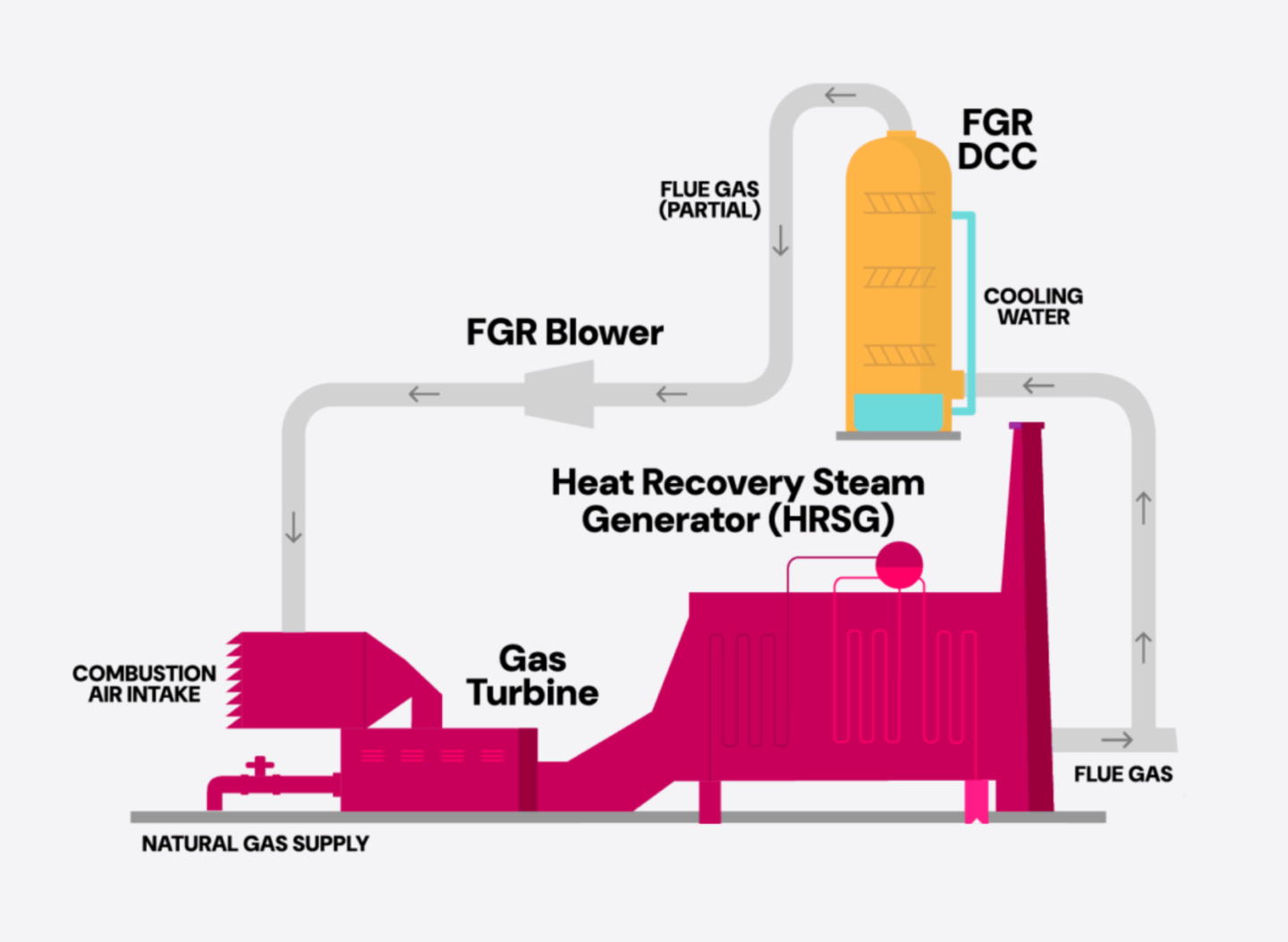
FGR redirects a portion of the flue gas back into the combustion air intake of the gas turbine. The recycled flue gas is mixed with ambient air and used for combustion again (for more information on this process visit our Flue Gas Recirculation Overview). This results in the flue gas going to the capture facility with a higher CO2 concentration and lower volumetric flow rate. The increase in low concentration can be significant: a study by GE found that 30% recirculation increased CO2 concentration in the flue gas by 40% (Gas Turbine Combined Cycle System Integration with Carbon Capture Plant for Improved Value). Because the same amount of CO2 is captured from a smaller volume of flue gas, the absorber and other process equipment can be smaller, reducing capital costs.
Reducing Capital and Operating Costs
By increasing the CO2 concentration and reducing flue gas volume, FGR allows pieces of capture equipment, particularly the inlet cooler and absorber, to be smaller. This reduces both the capital cost and the footprint of the facility. The GE study found that a CCS facility’s cost decreased by approximately 15% if 30% of the exhaust gas was recycled. These savings were mainly in the pre-scrubber and amine absorption systems. Because this integrated system would require additional cooling and modifications to the flue gas ducting, the total system costs were decreased by 5 to 8%. A FEED study for the US Department of Energy, led by GE Vernova, concluded that installing FGR would cost $74 million USD, and result in savings of $106 USD in the capture facility (Retrofittable Advanced Combined Cycle Integration for Flexible Decarbonized Generation).
Because a smaller volume of flue gas is processed, less solvent needs to be circulated through the system. Less solvent circulation reduces the heat required by the reboiler, lowering both energy consumed and operating costs. Sipoca et al. found that recycling 40% of the exhaust gas would result in a 9% decrease in the specific reboiler duty. If less energy is required for capture, more power can be generated by the NGCC facility (Natural gas combined cycle power plants with CO2 capture – Opportunities to reduce cost).
Flue gas recirculation can also extend solvent life. The FGR configuration reduces the amount of oxygen (O2) in the flue gas, reducing oxidative degradation in amine capture systems, and the cost of amine make-up. GE found that recirculating 30% of the exhaust gas reduced O2 concentrations in the flue gas by almost 20%. Nitrogen oxide (NOx) concentrations also decreased in the flue gas, as a result of the reduced O2 during combustion (Flue Gas Recirculation of the Alstom Sequential Gas Turbine Combustor Tested at High Pressure), which further reduced chemical degradation of the amine.
Engineering Challenges with Flue Gas Recirculation
The amount of flue gas that can be recirculated is limited by combustion requirements. The maximum recirculation rate for NGCC systems is about 40% of the flue gas. Because recirculated flue gas has relatively little oxygen, outside air needs to be added to make up the minimum 15% O2 concentration required in the combustion air for flame stability. The amount of power generated by the turbine may slightly decrease with higher FGR ratios: evaluations must be conducted to determine the optimum power generation and CCS cost scenarios (Energy and Economic Analysis of the CO2 Capture from Flue Gas of Combined Cycle Power Plants).
Flue gas recirculation also changes the composition of the combustion gases. While NOx concentrations decrease with FGR, carbon monoxide (CO) concentrations can increase, particularly at low loads. CO catalysts may need to be added to reduce CO levels in the flue gas. Also, if flue gas contaminants such as SO2 enter the gas turbine compressor, they can cause corrosion of rotating and stationary compressor components. The GE Vernova FEED study included corrosion resistant coatings and new compressor blades to mitigate corrosion caused by FGR.
Flue gas must also be cooled before it can be returned to the gas turbine. A cooler is required to ensure the stability of turbine operations. This is an addition to the cooling required for the capture facility. Direct contact coolers have often been specified, as they use water to both cool the flue gas and remove SOx and other contaminants. The additional cost of this cooling equipment must be balanced against the decreases in turbine performance that can occur when the combustion air temperatures increase.
While FGR is a well-established technology in several industries, it has not yet been used in a commercial application with carbon capture. Future demonstration projects will play an important role in validating performance, reliability and economics at full scale.