Optimizing Capture Costs: A Blog Series
We have created a series of blogs detailing how carbon capture isn’t just about capturing carbon dioxide (CO2), it’s about designing an entire system to do it efficiently. In this optimization series, we explore the engineering decisions that influence the cost, performance, and reliability of carbon capture and storage (CCS) facilities, and the trade-offs engineers make to optimize project outcomes.
Optimizing Energy
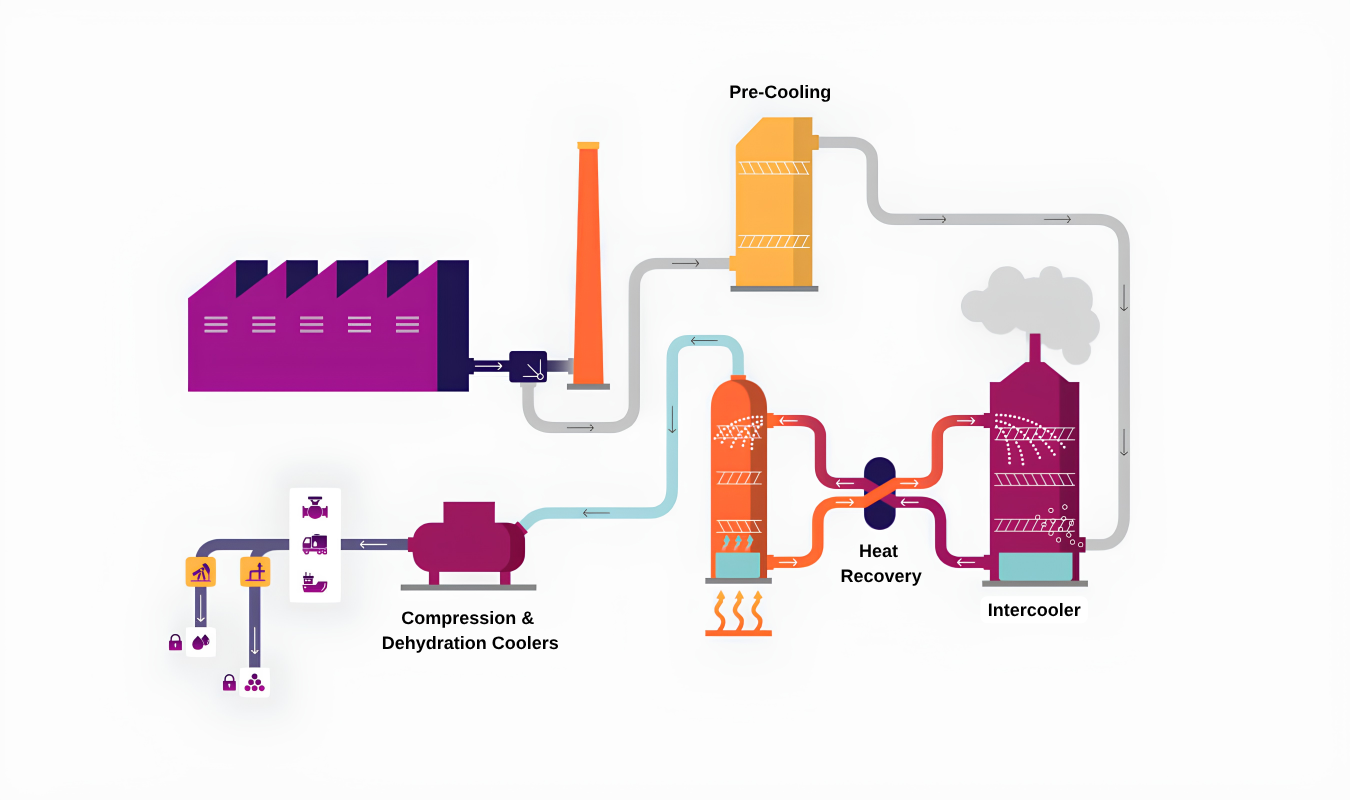
One of the largest operating costs for an amine-based capture facility is energy use. Energy is required to generate heat to separate CO2 from the solvent in the regenerator, and more energy is needed to compress the CO2 for transport to permanent storage. Even small improvements in these processes can impact the overall cost of capture.
The regenerator is one of the most important potential areas for optimization. By carefully selecting the operating conditions, engineers can reduce the amount of steam required to regenerate the solvent and lower fuel consumption or reduce the steam demand from the host facility. The operating conditions can also influence the pressure of the recovered CO2, which affects how much the compressor needs to do.
The Regeneration Process
After the amine has absorbed the CO2 from the flue gas, the “rich” amine is sent to a regenerator vessel. Here, heat is applied to the amine solvent, usually in the form of steam. The CO2 is released, and the amine is reused for capture. The released CO2 needs to be compressed and dehydrated before it can be transported.
The regenerator and the compressor can be optimized to work together. The pressure at which the CO2 leaves the regenerator determines how much additional compression is required for transport. Changing the regenerator’s operating temperature and pressure therefore affects both the amount of steam required and the energy needs of the compressor. Optimizing one system without considering the other may increase the facility’s overall energy consumption.
How Pressure Affects Performance
One of the most important operating decisions is deciding the pressure for the regenerator to operate. The pressure impacts the amount of steam required, the size of the regeneration equipment and the energy needed elsewhere in the capture process.
Regenerators typically operate between 150 and 200 kPa, corresponding to operating temperatures of 105-110°C. As pressure increases, the boiling point of the solvent also increases, requiring the regenerator to operate at a higher temperature. The higher temperatures change the equilibrium between CO2 and water vapour, which means the CO2 can be released more efficiently. This reduces the total heat required for regeneration.
The potential energy savings can be significant. One study found increasing regenerator pressure from 150 kPa to 300 kPa reduced the reboiler heat duty of a monoethanolamine (MEA) system by nearly 40%, though the benefits were smaller for other solvents (Re-Engineering the alkanolamine absorption process to economize carbon capture).
Operating at higher pressure can also reduce equipment size. Because CO2 is released more efficiently, the regeneration column can be designed smaller, reducing capital costs. In the same study, increasing the operating pressure from 150 kPa to 300 kPa reduced the diameter of the MEA regenerator from 9.5 metres to 7 metres.
These benefits are only part of the optimization. Increasing the regeneration pressure also influences the compressor and other aspects of plant performance. Engineers have to balance competing factors.
Reducing the Compressor Load
Operating the regenerator at a higher pressure provides an extra benefit. Because the CO2 leaves the regenerator at a higher pressure, the compressor has less work to do to reach the transportation pressure. As a result, less energy is needed for compression.
The reduction in compressor energy can be substantial. In the same study, increasing the regenerator pressure from 150 kPa to 300 kPa decreased compressor duty by approximately 20%, regardless of the type of amine. Overall, the study found that this increase in regenerator pressure resulted in a drop in the parasitic load on the host power plant from 54% to 38.7% for MEA, and from 38.3% to 33.6% for diethanolamine (DEA).
Balancing the Benefits of Higher Pressure
Increasing regenerator pressure offers several benefits but can’t continue indefinitely. As pressure increases, so do the operating temperatures, and they can reach conditions that accelerate solvent degradation. When amine molecules degrade, they can’t bond to CO2 effectively and need to be replenished.
Higher operating temperatures also require higher-temperature steam. Although the total amount of steam needed might decrease, higher-quality steam can be more valuable for the host facility. Engineers have to consider the quality of steam needed and its temperature when evaluating overall plant performance.
Increasing regenerator temperature also affects the equipment downstream. The regenerated solvent leaves the column hot, so more heat has to be recovered in the lean-rich heat exchanger.
Amine Blends
Higher regenerator temperatures can be practical if a different solvent is used. Proprietary amine blends often have higher thermal stability than MEA. Solvents can behave differently based on the flue gas composition that they’re managing, the oxygen levels, and impurities in the flue gas. Analysis must be done to determine the optimum amines for different kinds of flue gases and different operating parameters, as some amine molecules are more susceptible to heat, and some may be more prone to degradation from oxygen or flue gas contaminants.
No capture technology is optimal for every application. Solvent selection depends on many factors, like flue gas composition, operating temperature and pressure, and the presence of potential pollutants. Different amines produce different degradation products which also impact solvent replacement rates, reclaiming requirements, and waste management.
Performance is only one part of the equation. Proprietary amine blends can cost much more than conventional MEA, making lifecycle economics just as important as thermal performance. Long-term pilot testing helps engineers evaluate solvent degradation rates, identify degradation products and determine whether the operational benefits outweigh the higher costs.
Optimizing a System
Optimizing a capture facility involves more than minimizing the energy required to regenerate the solvent. Changes to the regenerator impact steam demand, compressor energy, solvent degradation, equipment size, and long-term operating costs. Improving one part of the process without considering the impacts to the rest can increase the overall cost of capture.
By selecting appropriate operating pressures, temperatures, and solvent formulas, engineers can optimize the performance of the regenerator. The optimal solution will vary from project to project, depending on the flue gas characteristics, the host facility, and the economic objectives.