Background
Northern Lights, a joint venture between Equinor, Shell and TotalEnergies, has developed the world’s first open-access, cross-border carbon dioxide (CO2) transport and storage network, enabling industrial emitters across Europe to reduce their emissions through the permanent storage of captured CO2. Offering transport and storage services, Northern Lights ships CO2 to its receiving terminal in Norway, where it is then transported by pipeline to an offshore reservoir beneath the North Sea for permanent storage.
The first phase of Northern Lights is part of Longship, a Norwegian Government initiative to develop Europe’s first full-scale carbon capture and storage (CCS) value chain. By funding a significant portion of the initial infrastructure, the Norwegian government aims to demonstrate that CCS can effectively decarbonize industrial emissions, while laying the foundation for a commercially viable CO2 transport and storage market that can be scaled over time.
Longship consists of three individual projects in Norway, two capture projects and one CO2 transport and storage project. The capture projects include Heidelberg Materials’ cement factory in Brevik and Hafslund Celsio’s waste-to-energy facility in Oslo, while the transport and storage responsibility falls to Northern Lights. Each industrial partner is responsible for the design, construction and operation of their facility.
Phase 1 of Northern Lights is now operational, achieving its first injection of liquefied CO2 for permanent storage in August 2025. The network has a transport and storage capacity of 1.5 million tonnes of CO2 per year, exceeding the 0.8 million tonnes per year reserved for the two Longship capture projects. The remaining capacity is available to third-party customers, allowing Northern Lights to offer commercial transport and storage services beyond the Longship project. Doing so, Northern Lights began serving its first commercial customer in March 2026, Inherit Carbon Solutions (Inherit), a Norwegian carbon removal project developer.
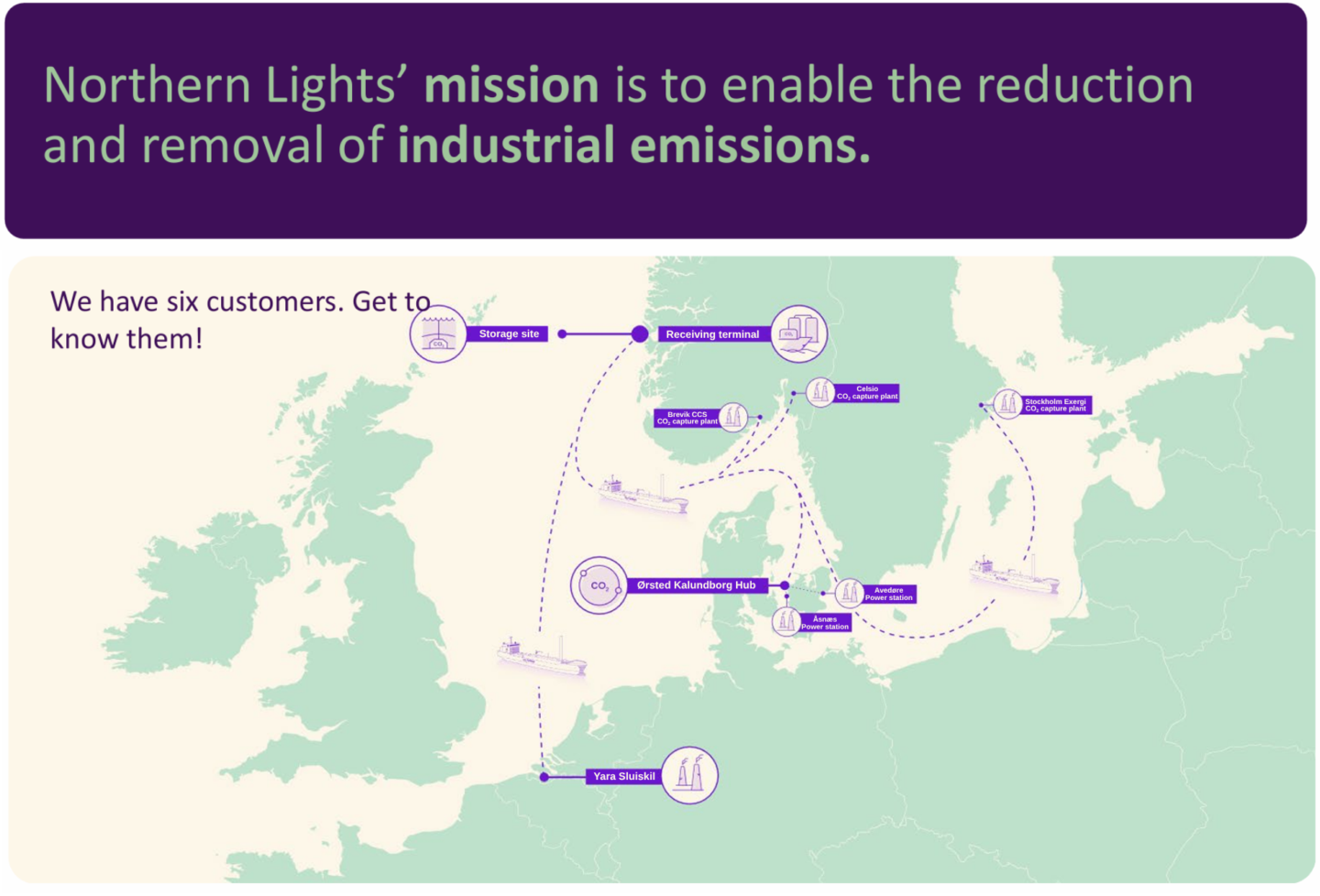
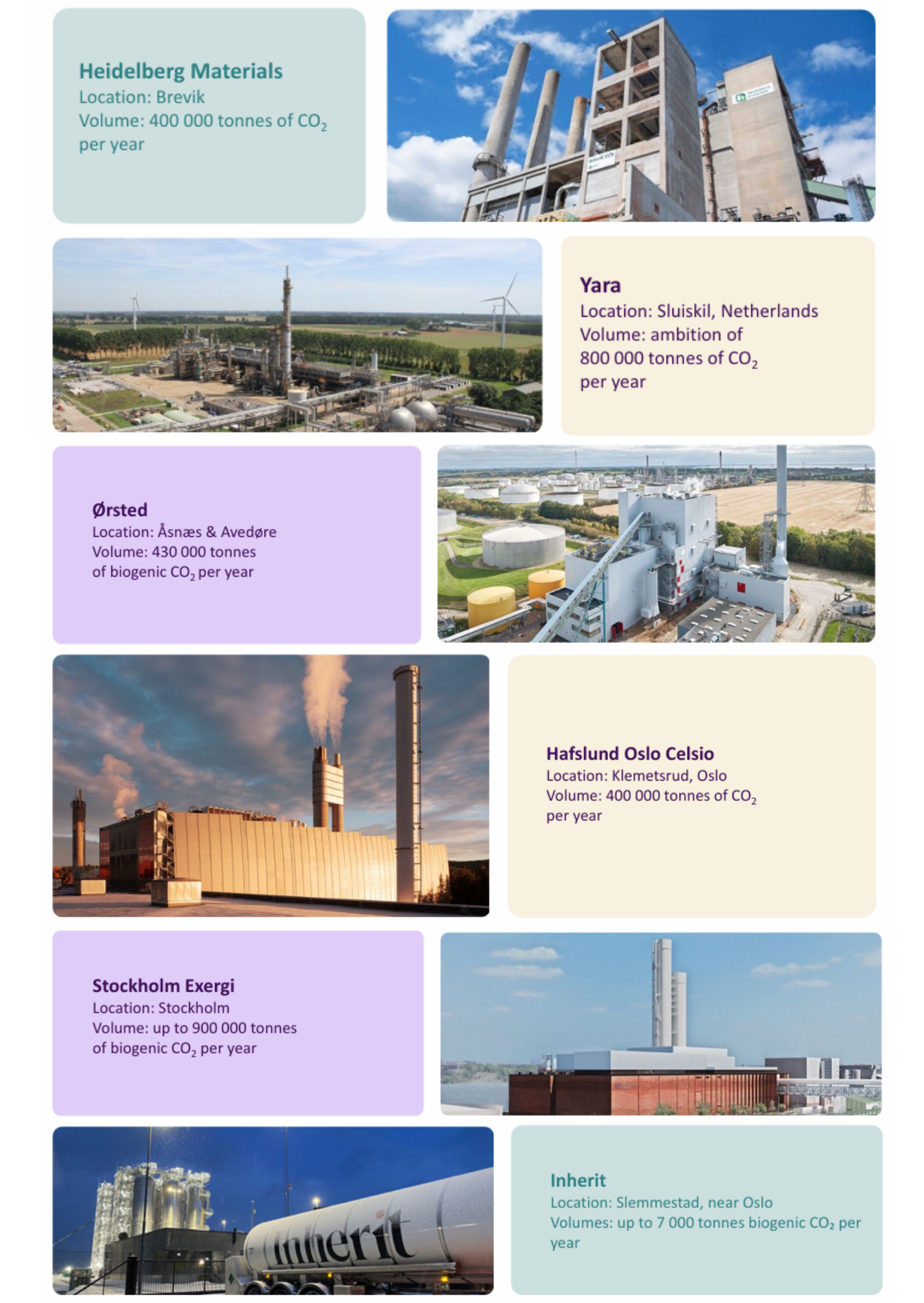
To meet growing demand from European industries, in March 2025 Northern Lights reached a final investment decision to proceed with Phase 2, expanding its annual capacity to a minimum of 5 million tonnes. Unlike Phase 1, which was developed as part of Norway’s Longship project, Phase 2 is being financed primarily through commercial investments, with the Connecting Europe Facility (CEF) grant helping to support the expansion. Commercial agreements with industrial customers including Yara in the Netherlands, Ørsted in Denmark, and Stockholm Exergi in Sweden demonstrates a growing market demand for transport and storage services and represents a significant milestone in establishing a commercial CCS market in Europe. Construction of Phase 2 began in August 2025 and is expected to be completed and operational in the second half of 2028.
As the first to develop infrastructure to transport and store CO2 across multiple countries, Northern Lights has a mandate to share its knowledge and experience internationally to support future CCS deployment. This commitment is delivered through several knowledge sharing activities, including ship events, technical workshops, operational briefings, and media engagement. The Northern Lights visitor centre, located at its receiving terminal in Øygarden, Norway, serves as a central platform for on-site knowledge sharing, welcoming visitors worldwide to observe CCS operations firsthand. In addition to the hands-on learning, annual experience reports are published as part of the Longship project’s knowledge sharing requirements to help future CCS projects reduce costs and risks. These reports document lessons learned from developing and operating the Northern Lights transport and storage system, which are available here.
How Does Northern Lights Work?
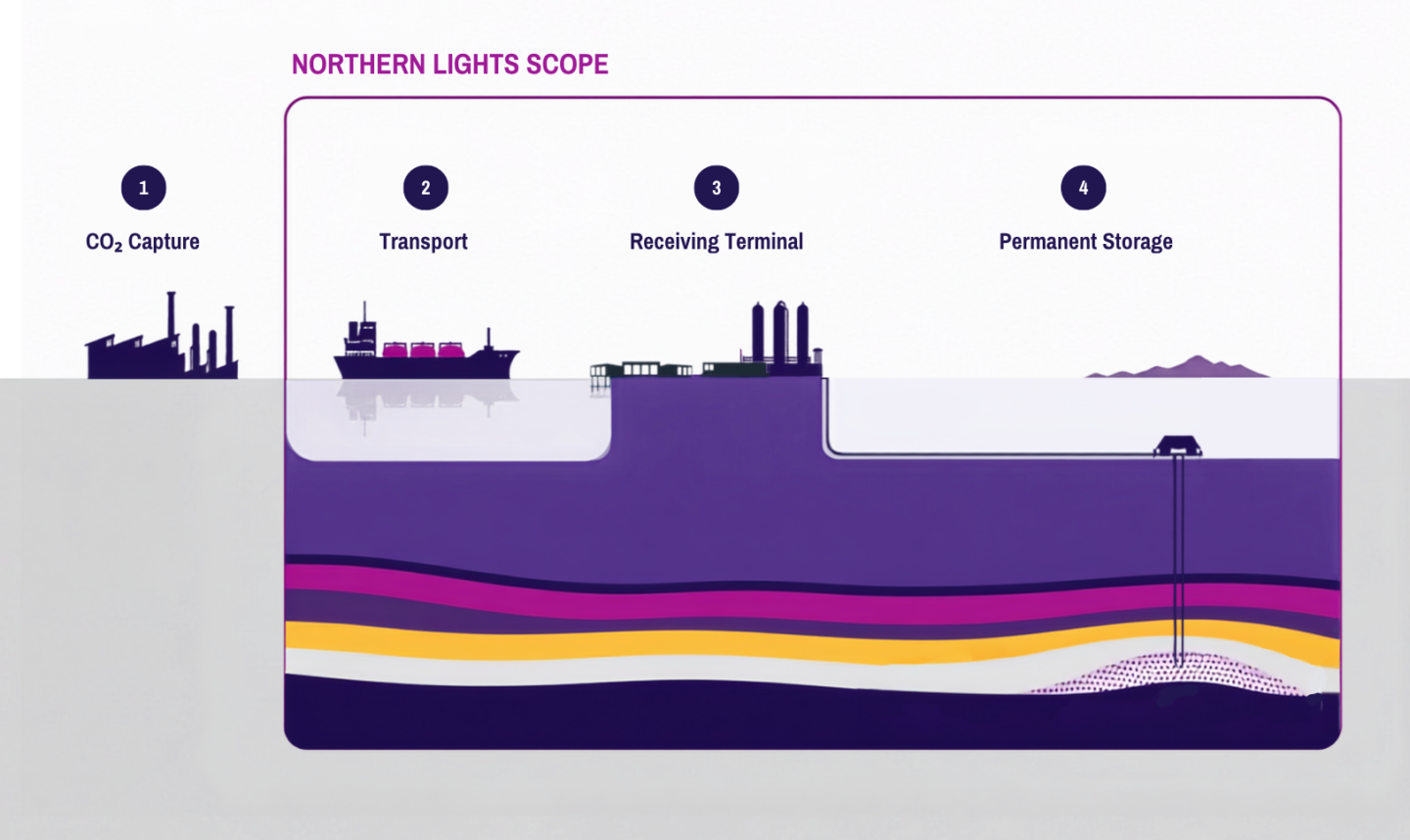
- CO2 Capture: Flue gas from industrial facilities is sent to a corresponding capture facility, where the CO2 is separated, compressed, and cooled into a liquid form to meet transportation and storage specifications.
- Transport: Northern Lights uses a fleet of purpose-built ships to transport the captured liquefied CO2 to its receiving terminal in Øygarden, Norway. The vessels are equipped with liquefied natural gas (LNG) dual-fuel propulsion systems which use LNG as their primary fuel. They also incorporate a wind-assisted rotor sail and air lubrication. Together, these innovative technologies lower the carbon footprint of these vessels compared to conventional ships operating on marine fuel.
- Receiving Terminal: Upon arrival, the liquefied CO2 is offloaded from the ships and temporarily stored in onshore tanks. The CO2 is then transported through a 110 km long subsea pipeline for offshore storage.
- Permanent Storage: Northern Lights stores CO2 in the Aurora storage complex, in a deep saline aquifer located approximately 2.6 km beneath the seabed in the North Sea on the Norwegian Continental Shelf. The CO2 is injected through a subsea well into the porous sandstone reservoir in the Johansen Formation. An overlying impermeable cap rock provides a secure seal, keeping the CO2 safely in place and preventing it from migrating back to the surface. The storage site is continuously monitored to ensure that the CO2 remains safely contained and behaves as expected.
Phase 1 Infrastructure
Shipping Fleet
The Phase 1 shipping fleet is comprised of three dedicated vessels, the Northern Pioneer, Northern Pathfinder, and Northern Phoenix, each 130 meters long with a cargo capacity of 7,500 m3 of liquefied CO2. Northern Pioneer and Northern Pathfinder became operational in 2025, transporting captured CO2 from Heidelberg Materials. Following its arrival in Norway in April 2026, Northern Phoenix began final commissioning activities and, as of the publication date of this document, has not yet entered commercial service. This vessel has been designated to transport captured CO2 from Yara’s capture project in the Netherlands, which is expected to become operational in 2026.
Receiving Terminal and Pipeline
Phase 1 of the onshore receiving terminal includes an import jetty (pier) for unloading liquefied CO2 from ships, 12 onshore storage tanks, pumps and heaters, and a 110 km long, 12” diameter subsea pipeline connecting the terminal to the offshore storage site. Construction of the receiving terminal began in 2021 and was completed in 2024. The facility entered operation in 2025, when it received its first delivery of CO2 from Heidelberg Materials’ cement plant.
The onshore facilities have a capacity of 1.5 million tonnes of CO2 per year, while the pipeline was designed with a transport capacity of up to 5 million tonnes per year. This additional pipeline capacity supports future expansion phases of the project. The receiving terminal was also designed with future expansion in mind, including space for additional storage tanks and a second jetty that would allow two ships to be received simultaneously.
Storage
The Aurora storage complex is part of Exploitation License EL001 which was awarded in January 2019. To confirm the reservoir’s high-quality characteristics and storage capacity, an exploratory well was drilled in 2020. Meanwhile, in 2022, two injection wells were drilled to support Phase 1 operations. Each well was designed to inject up to 1.5 million tonnes of CO2 per year into the Johansen Formation. To ensure reliable operations, one well serves as the primary injection well, while the second serves as a contingency well.
Northern Lights commenced storage operations in August 2025. As of December 15, 2025, a total of 35,914 tonnes* of CO2 has been injected into the offshore storage site.
Phase 1 Operations
Commencing Phase 1 operations in August 2025, Northern Lights has been providing transport and storage services for Heidelberg Materials, currently the only operational carbon capture project under the Longship initiative. In addition to supporting the Longship commitments, Northern Lights expanded its customer base in March 2026, when it began serving its first commercial third-party customer, Inherit. Additional details on the customers supporting Phase 1 operations are provided below:
- Heidelberg Materials (Longship Capture Project): Heidelberg Materials’ capture facility began operations in June 2025, becoming the world’s first full-scale carbon capture plant in the cement industry. This facility is designed to capture approximately 400,000 tonnes of CO2 annually.
- Hafslund Celsio (Longship Capture Project): Hafslund Celsio’s capture project paused construction in 2023 due to a significant increase in cost estimates. Following a cost-reduction phase and renegotiation of its state support agreement, construction resumed in 2026. The capture plant is expected to commence operations in Q3 2029, representing the world’s first full-scale carbon capture plant at a waste-to-energy facility. Once operational, it will capture approximately 350,000 tonnes of CO2 per year.
- Inherit (Third-Party Customer): Inherit is a Norwegian carbon removal project developer that provides verified carbon removal credits to buyers. The CO2 is captured from a biogas production unit located at the Veas wastewater treatment plant in Slemmestad, near Oslo. Inherit transports the liquefied biogenic CO2 by truck to the Northern Lights’ receiving terminal in Øygarden, where it is transferred for permanent offshore storage. This is the world’s first carbon removal project to permanently store biogenic CO2 captured from biogas production. Northern Lights began injecting CO2 from the project in March 2026 and is expected to receive up to 7,000 tonnes of CO2 annually as per the two-year agreement.
Lessons Learned
The lessons learned from Northern Lights Phase 1 include both technical insights gained from the development and operation of the transport and storage system, as well as broader lessons from the Longship project on enabling a full-scale CCS value chain in Europe.
Northern Lights Technical Lessons Learned
Northern Lights identified several technical lessons learned from the development and operation of Phase 1. Insights gained from CO2 ships, jetty design, CO2 product specifications, injection operations, and subsurface design improvements will help inform future CCS projects.
CO2 Ships
Challenge
- First-of-a-Kind (FOAK) CO2 Ships: The first two vessels, Northern Pioneer and Northern Pathfinder, are the world’s first large-scale liquefied CO2 carriers. Engineers encountered technical and operational challenges due to a lack of standardized design templates and operational benchmarks at the time of development.
Solution
- Improvements and Operational Benefits for Future Vessels: Lessons learned during the commissioning and operation of the first two vessels enabled the third vessel (Northern Pathfinder) to be designed to a higher technical and operational standard. Key improvements included:
- Main engine and LNG Fuel Gas Supply System: Challenges encountered on the first two vessels during the testing and commissioning of the LNG fuel gas supply system led to post-delivery engine performance problems. This required additional troubleshooting and technical interventions. For Northern Phoenix, improvements were adopted, including clarifying testing standards, improving information exchange with the original equipment manufacturer, and introducing enhanced validation protocols. This resulted in pre-delivery upgrades, such as revised engine software and improved gas-injection nozzles. As a result, the Northern Phoenix demonstrated higher engine reliability and performance on its maiden voyage.
- CO2 Cargo Trials and Process Optimization: The first two vessels conducted the first operational trials involving liquefied CO2, establishing the initial foundation for cargo-handling parameters such as flow rates, loading and discharge durations, and the behaviour of the cargo under operational conditions. These trials created a mature set of validated procedures, enabling more efficient and predictable operations for the Northern Phoenix.
- Shore Power Capability: Post-delivery experience from the first two vessels identified issues with shore-power integration, including instability and insufficient capacity during cargo operations. After identifying the root causes, Northern Phoenix was built with design modifications to accept higher-capacity shore power reliably, particularly during discharge operations. This allows the vessel to discharge at full capacity, improving schedule efficiency and offering potential fuel savings by reducing reliance on the vessel’s generators.
Jetty Design
Challenge
- Costly Modifications due to Early Jetty Design: The Northern Lights jetty was designed approximately two years before the ships reached detailed design. As a result, the jetty design relied on preliminary assumptions for key ship parameters, including final ship length, central manifold location, and other interface facilities. The jetty length was initially set to be 50 meters but was later reduced to 38 meters during design optimization. When final ship specifications became available, several discrepancies were identified, including an increase in vessel length and a change to the manifold placement. These changes resulted in misalignment with the jetty design and required costly modifications to the existing infrastructure.
Solution
- Flexible and Conservative Jetty Design: From the challenges identified, it was recommended that future jetty designs should be more flexible and conservative to accommodate changes in ship parameters. This includes incorporating sufficient design margins to address uncertainties during early-stage ship development.
CO2 Product Specifications
Challenge
- Evolving Understanding of CO2 Stream Impurities: Northern Lights published its original CO2 product specifications in 2019, defining the maximum allowable impurity concentrations to protect the integrity and ensure safe operation of its transport and storage infrastructure. As the CCS industry matured, a new understanding of the risks and uncertainties associated with impurities in CO2 streams, including impurity interactions and the development of corrosive fluids, led Northern Lights to revisit their original specifications. To learn more about why CO2 product specifications exist and how different impurities impact transport and storage systems, visit here.
Solution
- Updated CO2 Product Specifications: It is important for CO2 specifications to evolve with the maturing CCS industry. To incorporate new insights regarding the risks and uncertainties of impurities, Northern Lights updated their CO2 product specifications twice since 2019:
- 2024 Update: A DNV-led task force comprising of experts from DNV, Northern Lights, Equinor, Shell and TotalEnergies, reviewed the original specifications using the latest published research and industry expertise. The revised specifications focused on ensuring the safety and integrity of the Northern Lights infrastructure, by developing a specification that avoids the formation of corrosive fluids and ensures the injectivity of the CO2 for storage. In addition, the revision expanded the list of allowable impurities in the CO2 stream, enabling a broader range of industries to potentially access the Northern Lights value chain. The updated specifications can be found here.
- 2025 Update: New research, operational insights, and industry feedback led to further specification refinements. The updates lowered the allowable limit for hydrogen sulfide (H2S) to protect the mechanical integrity of the transport and storage system, while relaxing the limits on glycols and ethylene to broaden the range of customers that can use the Northern Lights value chain. The revised specifications were published in May 2025 and can be found here.
- Continuous Monitoring Throughout Operations: To ensure safe and reliable operations, Northern Lights will maintain a proactive approach to continuously monitor and evaluate CO2 quality and corrosion risks. In addition, Northern Lights will share insights and operational experiences with the CCS sector to develop best practices for other projects.
Injection Operations
Challenge
- Maintaining Continuous Injection: Efficient injection operations depend on a stable and continuous supply of CO2, requiring more coordination within the CCS value chain than originally anticipated. Northern Lights highlighted that variations in CO2 supply from the capture facility affected loading schedules and shipping plans, leading to frequent adjustments and temporary pauses in injection.
Solution
- Coordination Between all Parties in the CCS Value Chain: To maintain continuous injection operations, daily coordination between capture, transport, and storage operations was required. Robust logistic systems for collecting and transporting CO2 were also important to ensure an uninterrupted supply for the storage system.
Subsurface Design Improvements
Challenge
- Phase 1 Subsurface Design: The subsurface design for Phase 1 prioritized high integrity and operational reliability, shaping early technical decisions and design choices that were appropriate for de-risking a FOAK value chain. Operational experience later showed that some design assumptions, particularly around well injectivity, were more conservative than necessary.
Solution
- Phase 2 Well Plan: Experience gained from Phase 1 allowed subsurface, drilling and well teams to revisit key assumptions and identify opportunities to optimize the Phase 2 development plan. This was supported by a stronger, data informed understanding of the reservoir and system behaviour. Through risk-based evaluation of alternative injection schemes, the team assessed how different distributions of injection volumes could affect containment, pressure behaviour within the reservoir, and the risk of CO2 migration near license boundaries. Operational data and injectivity testing from Phase 1 also indicated that the original injection capacity estimates, which were based on water-based well tests, were conservative because CO2 behaves differently from water. These insights enabled the optimization of the Phase 2 well plan and generated cost savings by reducing the number of planned additional wells from three to two.
Longship Lessons Learned
As the first industrial CCS value chain developed under the current European legal framework, Longship overcame several challenges. The project had to overcome investment barriers, unlock final investment decisions, enable cross-border transport of CO2 for storage, and adapt frameworks established by the oil and gas industry. To enable the development of the world’s first full-scale CCS value chain, close collaboration between government, industry participants, and regulatory authorities was instrumental in overcoming these challenges.
Overcoming Investment Barriers
Challenge
- Investment Barriers: CCS was not commercially viable for the Longship industrial partners without government funding, creating a significant barrier for project development and investment. In addition, all the projects were FOAK, exposing them to higher project uncertainties than those typically faced by more mature industries.
Solution
- State Aid Agreements: To enable project development and address FOAK uncertainties, the Norwegian government provided significant financial support to each Longship participant through separate state aid agreements. Costs were shared (up to agreed caps) between the state and industry, covering both capital and operating expenses.
- For Northern Lights, the state aid agreement covered a large share of the costs associated with developing Phase 1 transport and storage infrastructure. Phase 1 capacity was intentionally developed beyond the requirements of the Longship capture projects to facilitate future commercial customers, as the Longship capture projects are not required to pay for transport and storage services during the first 10 years of Northern Lights operation. Future revenues from tariffs paid by commercial customers create a strong incentive for Northern Lights to attract new projects and develop a customer base across Northern Europe, supporting a long-term business case.
Unlocking Final Investment Decisions
Challenge
- The CCS “Chicken and Egg” Investment Dilemma: Emitters won’t invest in capture projects without an available transportation and storage solution, and no company will develop transportation and storage infrastructure without a guaranteed supply of CO2.
Solution
- Splitting the CCS Value Chain into Independent Projects: Separating the capture projects from the transportation and storage project was a prerequisite for unlocking investment decisions. This structure allowed each proponent to focus on its own scope without waiting for the entire system to be in place. The Norwegian state supported this approach through state aid agreements that managed interface risks between the projects, ensuring each participant was primarily responsible for the risks within its own scope rather than risks arising from other parts in the value chain. This reduced uncertainty for each project developer and supported final investment decisions across the CCS value chain.
- Project Integrator Role: To coordinate the industrial partners in Longship, the Norwegian authorities established Gassnova as the project integrator. They were responsible for developing the design basis for the CCS chain, managing the overall project schedule, coordinating interfaces between partners, and ensuring that the projects are developed in line with the state’s objectives. They also helped to align different corporate cultures, work processes, and expectations across the CCS value chain. In addition to coordinating the development of Longship, Gassnova regularly publishes reports and project updates to share lessons learned and support future CCS developments, those reports can be found here.
Enabling Cross-Border Transport of CO2 for Storage
Challenge
- London Protocol Barrier: The London Protocol initially prohibited the cross-border transport of CO2, even for the purpose of offshore storage. This created a major barrier for Northern Lights, whose long-term business model depended on transporting and storing CO2 from emitters in other European countries.
Solution
- Provisional Amendment and Bilateral Agreements: In 2019, parties to the London Protocol agreed to provisionally apply a 2009 amendment that permits the cross-border transport of CO2 for offshore storage, provided that the participating countries (i.e., Norway and the country where the emissions originate) have established a bilateral agreement. Once this agreement is in place, Northern Lights can enter into commercial agreements with international partners, which is particularly important for the development of Phase 2.
Adapting Frameworks Established by the Oil and Gas Industry
Challenge
- Adapting Oil and Gas Frameworks for CCS Projects: Northern Lights was developed using many of the technical, regulatory, and operational frameworks established by Norway’s offshore oil and gas expertise. While this approach helped progress project development by leveraging existing design and regulatory processes, these frameworks were not always fit for purpose for CCS applications, leading to the following challenges:
- Regulations and Risks: As CCS is an emerging sector, the storage of CO2 was regulated based on existing oil and gas regulations. However, the risks associated with a CO2 leak in the North Sea are substantially different than the risks associated with a petroleum leak.
- Increased Design and Engineering Time: Operating conditions differ from most oil and gas facilities, as the liquid CO2 needs to be transported under moderate pressures and low temperatures. As a result, significant engineering effort was required to adapt existing oil and gas specifications towards CCS applications, with some solutions resulting in over-design.
- Storage Regulations Uncertainty: Norway’s licensing system for CO2 geological storage is similar to their petroleum licensing system. The system consists of permits and obligations that apply throughout a project’s lifecycle, including pre-operation, operation, decommissioning, and transfer of liability to the Norwegian state. However, CCS is an emerging industry, with higher financial risks and lower margins than the petroleum sector. Uncertainties regarding how the Storage Regulations would be enforced (i.e., monitoring obligations, conditions for transferring future liabilities to the state, third-party access to the storage site, etc.), increased the risk for Northern Lights, making it challenging to make a final investment decision.
Solution
- Create Fit for Purpose Design: Future CCS projects would benefit from a dedicated set of guidelines tailored to the unique characteristics, risks, and operating conditions of CO2. Rather than modifying an existing set of oil and gas requirements, Northern Lights would recommend that future CCS design should start from zero and provide arguments for adding in requirements.
- State Involvement: To reduce regulatory and long-term liability risks, the Norwegian state assumed a portion of the risks associated with CO2 storage through the state aid agreement. This included covering part of the risk associated with a potential, though unlikely, leakage from the storage reservoir once CO2 has been injected under the Longship project. To further reduce Northern Lights’ exposure to long-term liability risk, its liability for any leakage of CO2 from the Longship projects during the operational period was capped at an ETS price of EUR 40 per tonne. To reduce financial uncertainty associated with eventual site closure, the Norwegian authorities committed to providing closure support for eligible removal costs. Finally, once regulatory requirements are met and long-term storage stability has been demonstrated, the responsibility for the storage site and future liabilities can be transferred to the state, following a minimum 20-year monitoring period. This risk-sharing framework helped reduce investment uncertainty and supported Northern Lights’ final investment decision.
Conclusion and Next Steps
Northern Lights has transformed the concept of cross-border CO2 transport and storage into a proven commercial reality. By successfully developing and operating its Phase 1 infrastructure, Northern Lights has demonstrated that CCS can be safely and reliably deployed at industrial scale.
Funding from the Norwegian Government through the Longship project was instrumental in reducing risk and unlocking private-sector investment to develop Europe’s first CCS value chain. This support established the foundation for Northern Lights to expand beyond Longship and offer commercial transport and storage services to industrial emitters across Europe, becoming the world’s first to transport and store CO2 from multiple countries.
Phase 2 development is currently underway and will increase Northern Lights’ annual transport and storage capacity from 1.5 million tonnes to 5 million tonnes by 2028. The expansion includes increasing the shipping fleet to eight vessels, adding onshore storage tanks and pumps, constructing a new jetty to accommodate larger and more frequent CO2 shipments, extending the subsea pipeline system, and drilling two new offshore injection wells. Supported by commercial agreements with industrial customers in the Netherlands, Denmark, and Sweden, Phase 2 marks Northern Lights’ transition from a FOAK demonstration project to a scalable and commercial CCS service.
Through its extensive knowledge-sharing, Northern Lights has established itself as a global reference point for CCS. The lessons learned from both Northern Lights and the broader Longship project provide valuable technical, regulatory, and operational insights that can help reduce risk, improve project delivery, and accelerate the development of future CCS projects worldwide.