Optimizing Capture Costs: A Blog Series
We have created a series of blogs detailing how carbon capture isn’t just about capturing carbon dioxide (CO2), it’s about designing an entire system to do it efficiently. In this optimization series, we explore the engineering decisions that influence the cost, performance, and reliability of carbon capture and storage (CCS) facilities, and the trade-offs engineers make to optimize project outcomes.
Choosing the Right Cooling System
Selecting the right cooling system can be just as important as selecting the right capture technology. Every carbon capture facility requires more than just a capture technology. Supporting infrastructure, like the cooling system, play important roles in performance, reliability, and costs. There is more than one cooling technology available, and each option has different costs, operating characteristics, and resource requirements. Water-cooled systems typically require less equipment and can perform better than air-cooled systems, but they consume water. Air-cooled systems reduce water demand but require larger equipment and are more sensitive to warm weather. Designing the optimal solution can unlock significant cost savings, but the project’s location, available resources, and operating objectives all need to be considered.
The piece Managing Excess Heat in a Capture Facility explained how cooling performance is impacted by weather conditions, and the next question is how engineers select the cooling technology that best matches those conditions.
Cooling Requirements
Cooling is required throughout the capture facility – it’s not limited to one part of the process or a single piece of equipment. Heat must be managed at multiple points in the process, so several heat exchangers and cooling circuits are needed to keep the facility operating safely and efficiently.
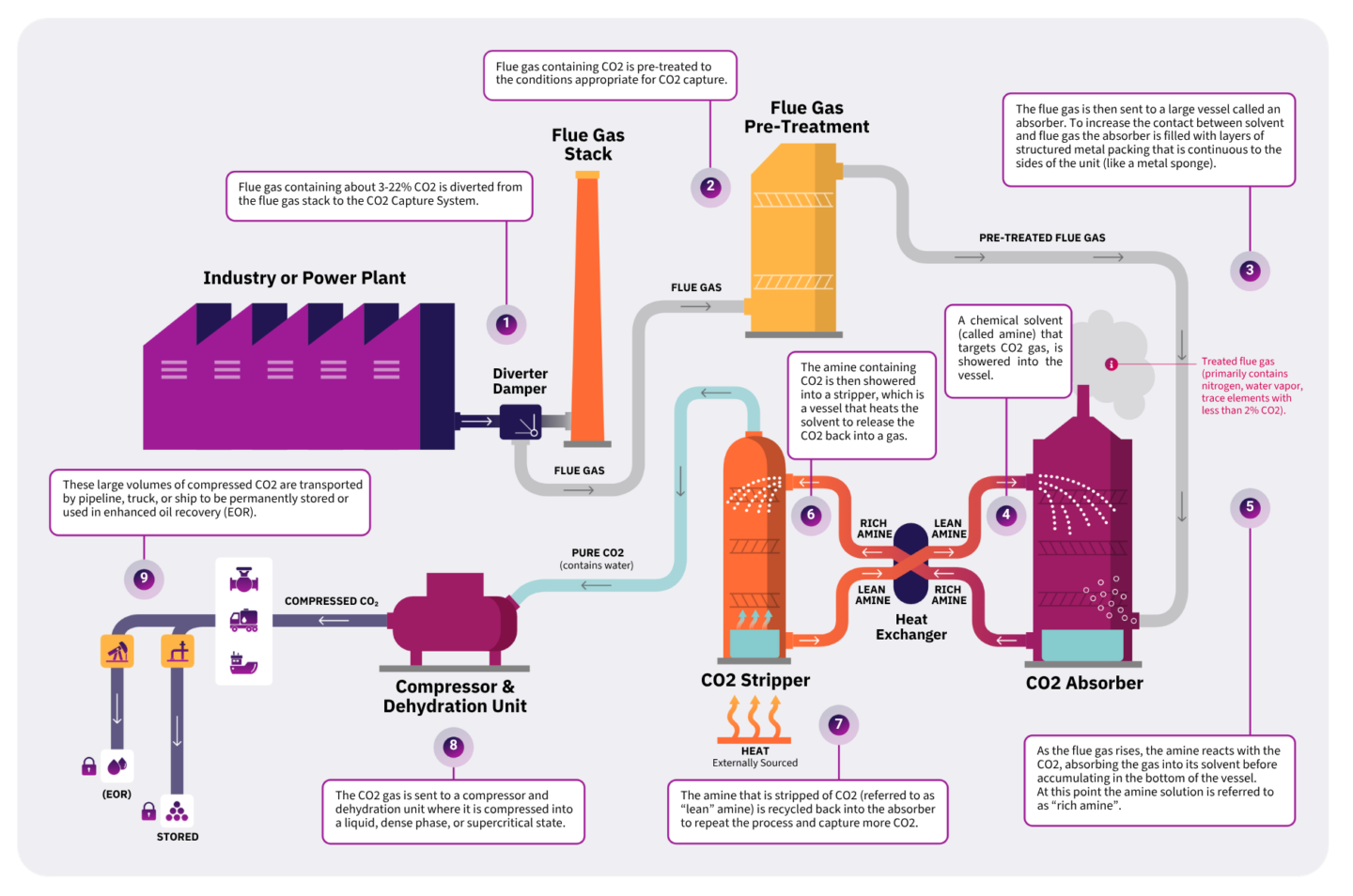
In a typical post-combustion capture system, cooling begins before the flue gases even enter the absorber. In amine-based absorption systems, the amine also needs to be cooled mid-way through the absorption process. As the amine absorbs CO2, heat is released through an exothermic reaction. After the CO2 is stripped away from the amine in the regenerator, both the regenerated solvent and the CO2 need to be cooled down. Additional cooling is also required after each stage of compression and may be needed during CO2 dehydration before transport.
Cooling Systems
Engineers can choose from three cooling approaches for a capture facility: water (evaporative cooling), air, or a hybrid system which uses both water and air. Water-cooled systems have the lowest capital and operating costs of the three options, but, unsurprisingly, they consume the most water. The way a water-cooled system works is to remove heat by evaporating a portion of the cooling water. This water is lost to the atmosphere and so it must be continually replaced with make-up water. Air-cooled systems use ambient air as the cooling medium, eliminating most water consumption. As discussed in Managing Excess Heat in a Capture Facility, their performance depends on the ambient dry-bulb temperature, and their cooling capacity may be limited on hot days. Hybrid systems combine water and air cooling to balance cooling performance with water consumption. By using different cooling technologies for different parts of the process, they can reduce water use while maintaining reliable operations in the heat.
Comparing Costs
Studies comparing cooling technologies have consistently showed that evaporative cooling systems have lower capital and operating costs than air-cooled systems. For example, the Nutrien Redwater CCS project (Nutrien Redwater Knowledge Transfer Plan) found the total installed cost of a water-cooled system was approximately 17% lower than the air-cooled system and the operating costs were 2% lower. The higher costs for an air-cooled system largely came from the electricity required to run fans, which exceeded the cost of importing additional water for the water-cooled system. The study also found that the air-cooled configuration needed approximately 5.4 times more footprint than the evaporative cooling tower configuration.
Similar conclusions have been reached in other studies. The IEAGHG Technology Collaboration Programme (Understanding the cost of reducing water usage) found that, for post-combustion carbon capture at a power plant, an air-cooled configuration increased the levelized cost of electricity by about 5% compared to an evaporative cooling system.
Benefits Beyond Cooling
The cooling system selected affects more than just the cooling equipment – it can also influence the performance of the carbon capture process itself. Because evaporative cooling can achieve lower temperatures than air cooling, the amine enters the absorber tower cooler, which improves its ability to capture CO2. As a result, less solvent needs to circulate through the system to achieve the same CO2 capture rate. Lower solvent circulation can reduce solvent losses and amine emissions while allowing smaller process equipment and slightly decreasing the capital and operating costs of the capture system.
Net Water Consumer or Producer?
The choice of cooling system can determine whether a carbon capture facility is a net consumer or producer of water. When air cooling is combined with recovering condensate from the flue gas, some capture systems can be net producers of water. Emissions Reduction Alberta’s Carbon Capture Kickstart program (ERA Lessons Learned 2024) identified several projects with this potential. On the other hand, water cooling systems consume more water than can typically be recovered from the flue gas, making them net water consumers.
The difference can be significant. The IEAGHG report found that for a natural gas-fired power plant, adding a capture system with water cooling increases water consumption by 54% while using air cooling decreases total water consumption by 34%.
Recovered flue gas condensate can be treated to remove impurities before being reused in the capture facility or host plant. It may also provide a source of make-up water for hybrid systems, reducing overall water demand.
Water Availability Matters
Water availability varies significantly across different regions and can be an important factor when selecting a cooling system. While evaporative cooling systems are generally lower in capital and operating costs, increased water consumption may not be appropriate. Freshwater resources may be limited, environmental regulations may be stringent, or there may be competing demands for water use.
Project developers should evaluate the design of their cooling system alongside the regional water availability, environmental policies, seasonal variability in water supply, and long-term climate projections. In some cases, the operational and economic benefits of evaporative cooling may outweigh the increased demand for water. In others, air cooling or hybrid systems may be a better overall solution despite the higher capital costs.
Where process-affected water is generated, local regulations may also impact the design of the cooling system. For example, some jurisdictions require industrial process water to be contained, treated, or reused rather than discharged to the environment. These requirements need to be considered alongside system selection and overall water management strategies.
Smarter Air-Cooling Design
Although air-cooled systems have typically had a higher capital cost than evaporative cooling, recent project experience suggests that the configuration of the equipment can bridge the capital gap. For large capture plants (greater than 1 million tonnes of CO2 per year), much of the additional cost comes from the supporting infrastructure required for large air-cooling installations, including piping, structural steel, electrical systems, and instrumentation.
One way to reduce these costs is to consolidate the air-cooling equipment into fewer, larger units. Air coolers normally use 30-to-40-foot tubing bundles. By moving to a 60-foot+ bundle design, project owners have the potential to achieve significant cost savings. One large-scale project study (more than 1.5 million tonnes of CO2 per year) demonstrated that consolidating the cooling bank into larger units saved approximately $50 million in capital. These savings are realized across several categories, including but not limited to:
- Civil & Structural: Larger air-cooler modules require fewer foundations and less structural steel.
- Piping & Mechanical: Consolidating equipment reduces headers, valves, and manifold connections, simplifying the piping network.
- Electrical & Instrumentation: Fewer fans and larger modules reduce cable runs, motor control centres, switchgear, and instrumentation requirements.
Maintenance Trade-Offs
Larger air-cooler bundles can reduce capital costs, but they also change how the equipment is maintained. Because the equipment is larger, maintenance activities may require specialized rigging for bundle pulls and the increased number of fans in each bay can mean more comprehensive vibration monitoring. For many project owners, however, the operational considerations are outweighed by the benefits of managing fewer individual pieces of equipment and the significant reductions in capital infrastructure.
Finding the Right Balance
There is no perfect cooling system for a carbon capture facility. Evaporative cooling can reduce capital costs, improve capture performance, and lower energy consumption, but these benefits have to be balanced against increased water use and regional water availability. Air-cooled systems reduce water demand and may even make a facility a net producer of water, however they typically require larger equipment and more capital investment. Hybrid systems are another option that can combine the strengths of both approaches.
Ultimately, selecting the right system is a site-specific engineering decision. Climate, water availability, facility layout, operating costs, maintenance requirements, and project objectives all influence design. By evaluating these factors together, engineers can design the cooling system to support reliable operations and maximize long-term project value.